Field Report · Tech Stacks
The Voice AI Shootout: What I Told a Founder Through Three Stacks
A founder I coach rebuilt the voice of his product three times before launch: 15 cents a minute, then 8, then 10. The advice I gave him at each switch, and how OpenAI Realtime, Grok, ElevenLabs, Retell, Vapi, Gemini Live and others compare as of November 2026.

Since June I've been coaching a founder who is building a voice AI product. I'll leave his name and his app out of it, because the build is his. He ran the experiments, did the rebuilds and found the numbers below. My part was the advice: what to watch, when to switch and what to keep. That advice is what this piece is about, because almost all of it applies to anyone picking a voice stack right now.
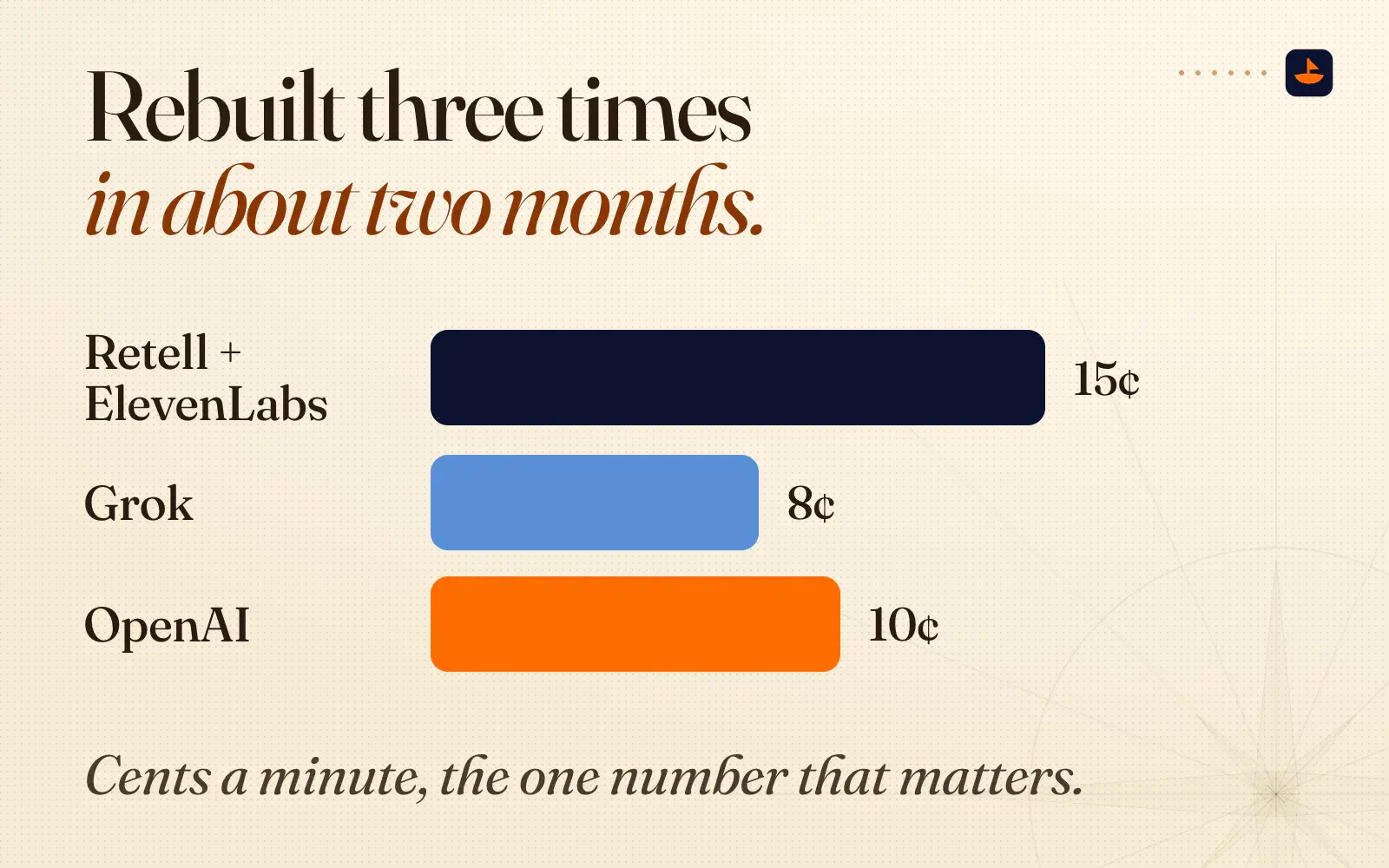
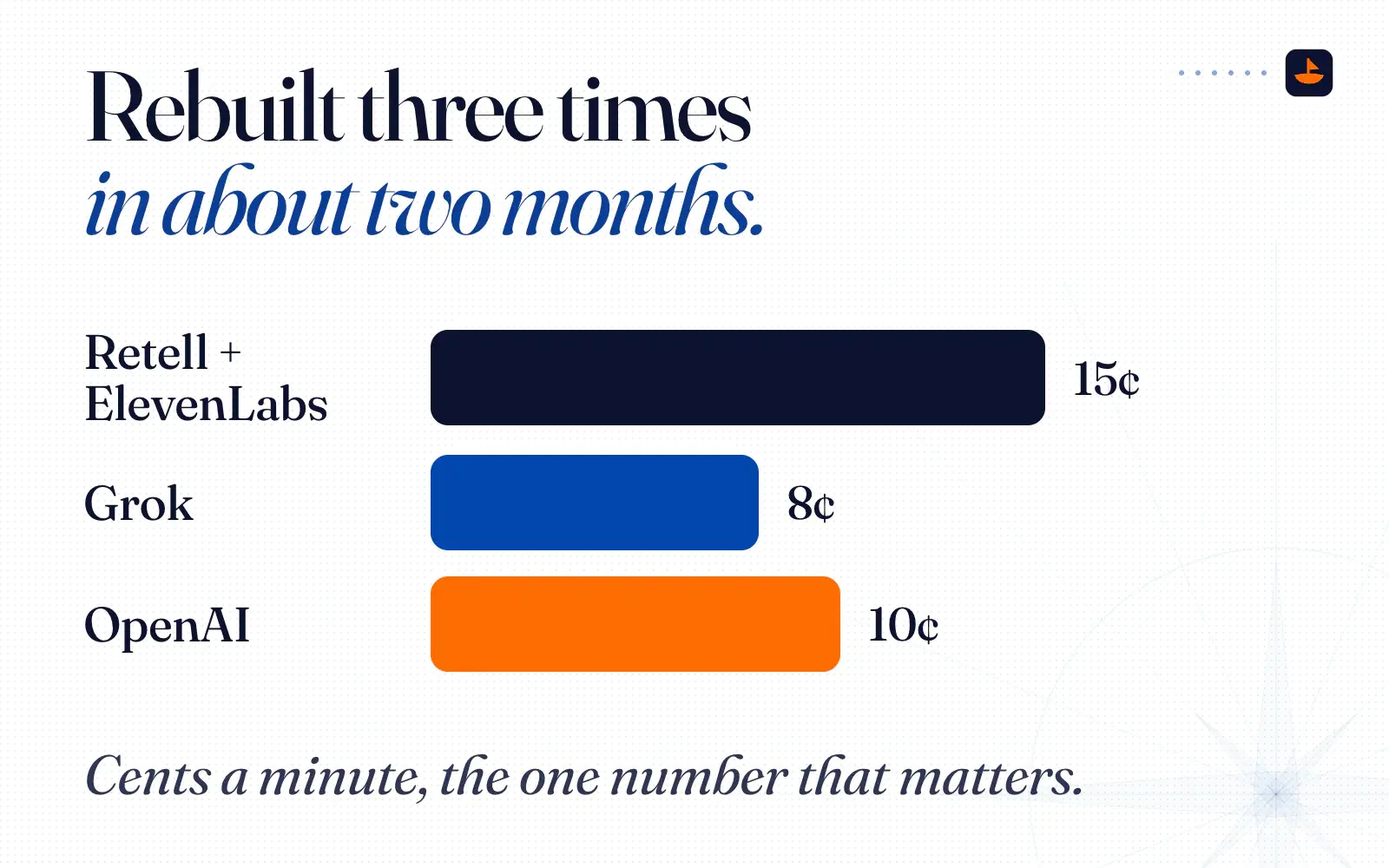
In about two months he rebuilt the voice of his product three times. The first stack cost him 15 cents a minute, the second cost 8 cents, and the third cost 10 cents. So this is the shootout: what he found, what I told him at each fork, and how the major voice AI options compare as of November 2026.
The one number that matters
I've followed voice AI as a fan for years. I was an early ElevenLabs user, mostly so I could have my email newsletters read to me. I once spent a weekend giving one of my own AI agents a voice and a phone number so it could call restaurants and book tables for me. As I told him the first time we talked about building with voice, "It's amazing the amount of work we'll do to avoid doing a little bit of work."
When we planned his build in July, the thing I kept pushing was cost. Every minute a user spends talking to a voice AI costs the builder money, so the whole business sits on one figure. Cost per minute, I told him, is the "most important raw cost you should be thinking about for this entire project. You're fortunate that it can be boiled down to a single KPI."
I also told him I couldn't vouch for how fast any of the platforms were that month, so he should sign up for free accounts on Retell, Vapi and ElevenLabs and test them himself. And I flagged OpenAI's realtime voice as the expensive option: "it's almost a quarter a minute." That matched its launch pricing. When OpenAI opened the Realtime API in October 2024, audio cost about 6 cents a minute going in and 24 cents a minute coming out. Prices have moved a long way since then, and OpenAI is where he ended up.
Stack one: a pipeline at 15 cents a minute
He started on Retell, a voice agent platform, and I backed that. I'd had a good experience with Retell myself, and I thought he could get a first version working in about a day. Retell runs what's called a pipeline. The user's audio is transcribed into text, the text goes to a language model, and the model's reply goes to a voice engine that speaks it. Retell assembles that chain and handles the phone side.
I sold him hard on ElevenLabs for the voice. I told him that with "the excitement tone, the concern tone, the skeptical tone," he'd have "complete promptable control." Retell carries some ElevenLabs voices, and switching to them raised his cost from 11 cents a minute to 15. He decided it was worth it and spent days with Claude tuning voice temperature and other settings.
The voice wasn't what I most wanted him thinking about, though. I told him to keep the voice layer "super light," because things need to pass in and out of it fast, and I described it as "just the face, the voice that they're talking to. But it's like an actor, it's an empty vessel." The real asset was the material he fed it: the scenarios and personas that make a conversation worth having. I pushed him to build that from real research and real conversations, because it has nothing to do with code or with Claude. When he showed me the library he'd written, I told him, "That's that intellectual moat."
Even so, after dozens of test calls on the pipeline, he still wasn't happy. To his ear it sounded glitchy.
The teardown
He'd been testing his build against three competitors. It beat two of them. The third sounded smoother and graded better.
Back in July I'd told him to find out what his competitors run on, because the voice and language models underneath are "the meat and potatoes that will be powering yours." I gave him the easy routes first. A lot of companies say proudly on their site what they use. Founders often talk about their stack on X or LinkedIn. Browser extensions can show what technology a site runs. Pricing is a clue too: "If they're not charging much and the tech feels laggy, they're using the cheapest models they can." And if the competitor you like least runs on a certain vendor, cross that vendor off.
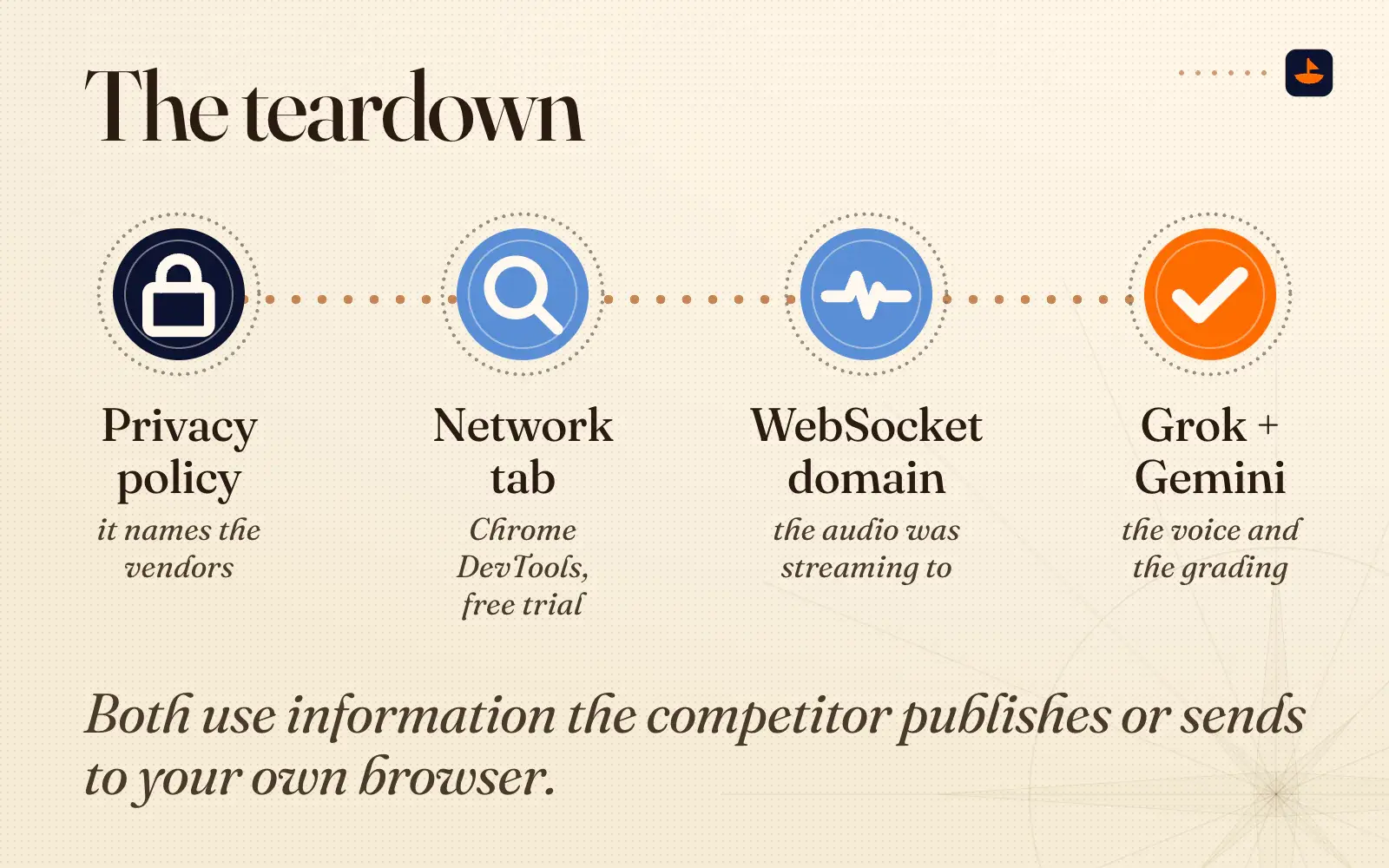
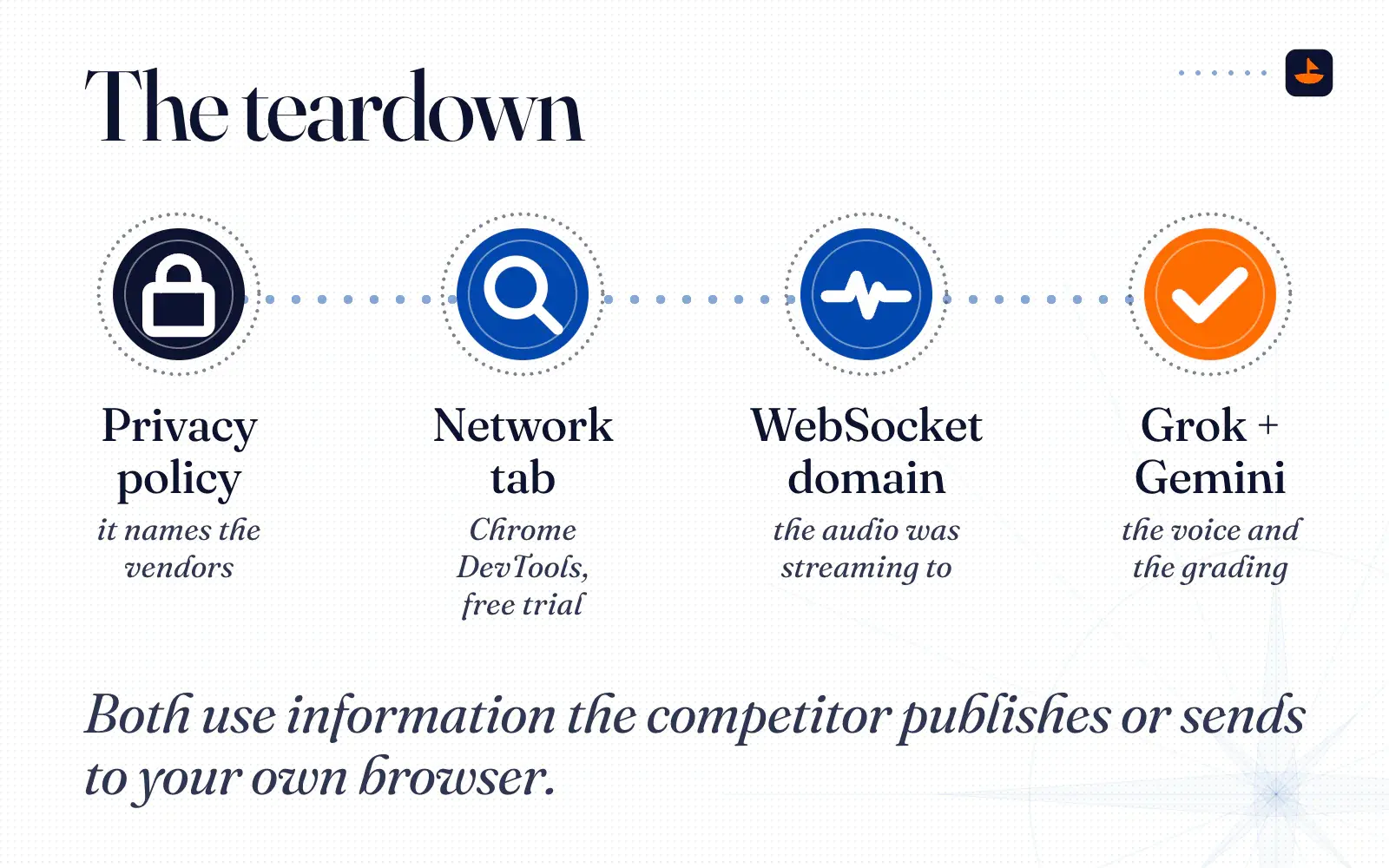
He went further than I'd suggested. One night he sat down with Claude and worked it out in two steps. Both use information the competitor publishes or sends to your own browser.
- Read the privacy policy. Privacy policies often list subprocessors, the outside companies that handle your data on the company's behalf. Almost nobody reads that list, and it names the vendors.
- Open the Network tab. On the competitor's free trial, he opened Chrome DevTools, started a call, filtered the network traffic and read the WebSocket domain the audio was streaming to.
The answer was Grok for the voice and Gemini for the grading. His write-up for me spelled out the difference. His stack was a pipeline of separate vendors. The competitor sent speech straight into one model from one vendor, audio in and audio out. Fewer hops meant lower latency by design. And because the model heard the audio itself, the competitor could score how a user sounded, not just what they said.
Stack two: audio-native at 8 cents a minute
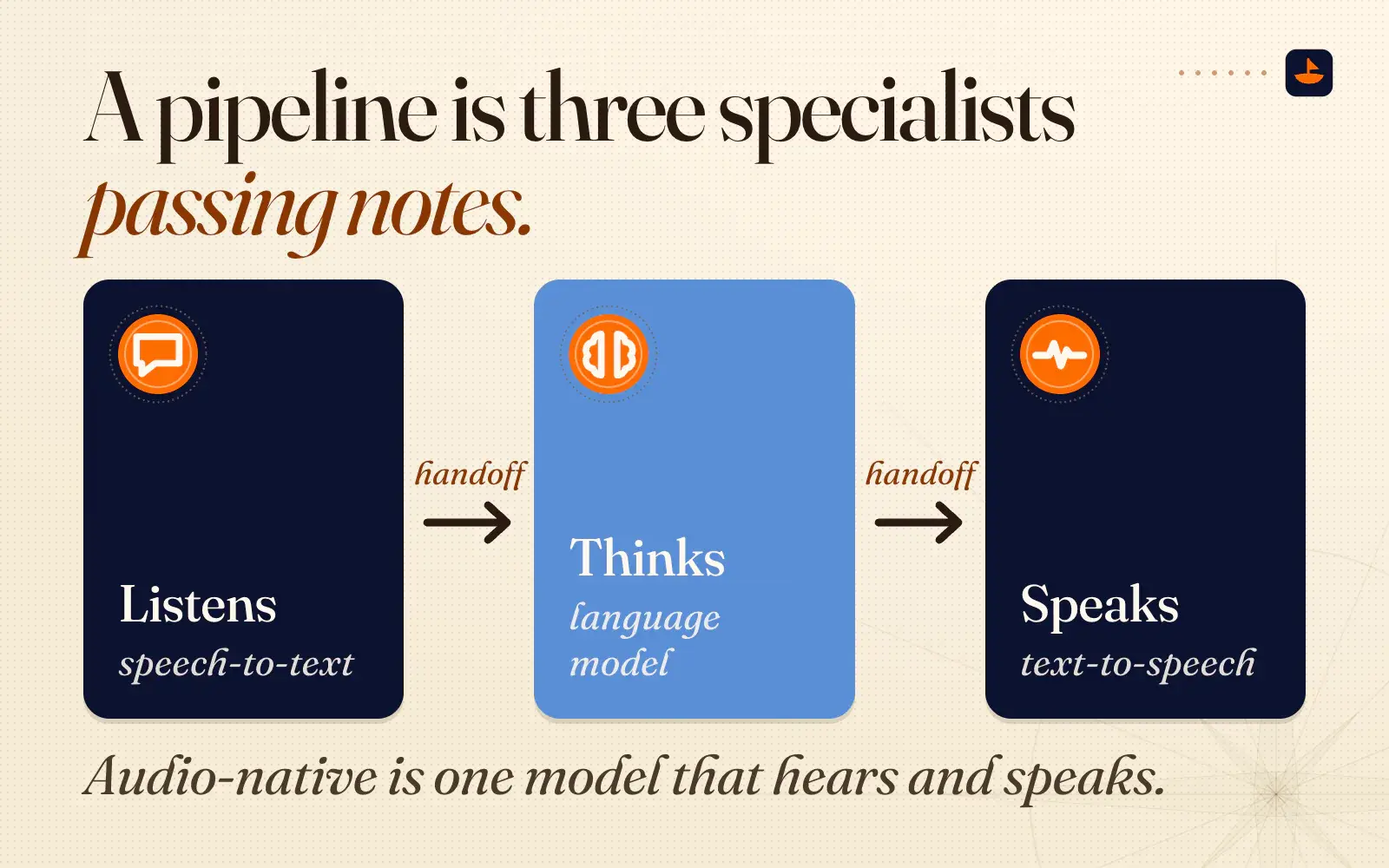
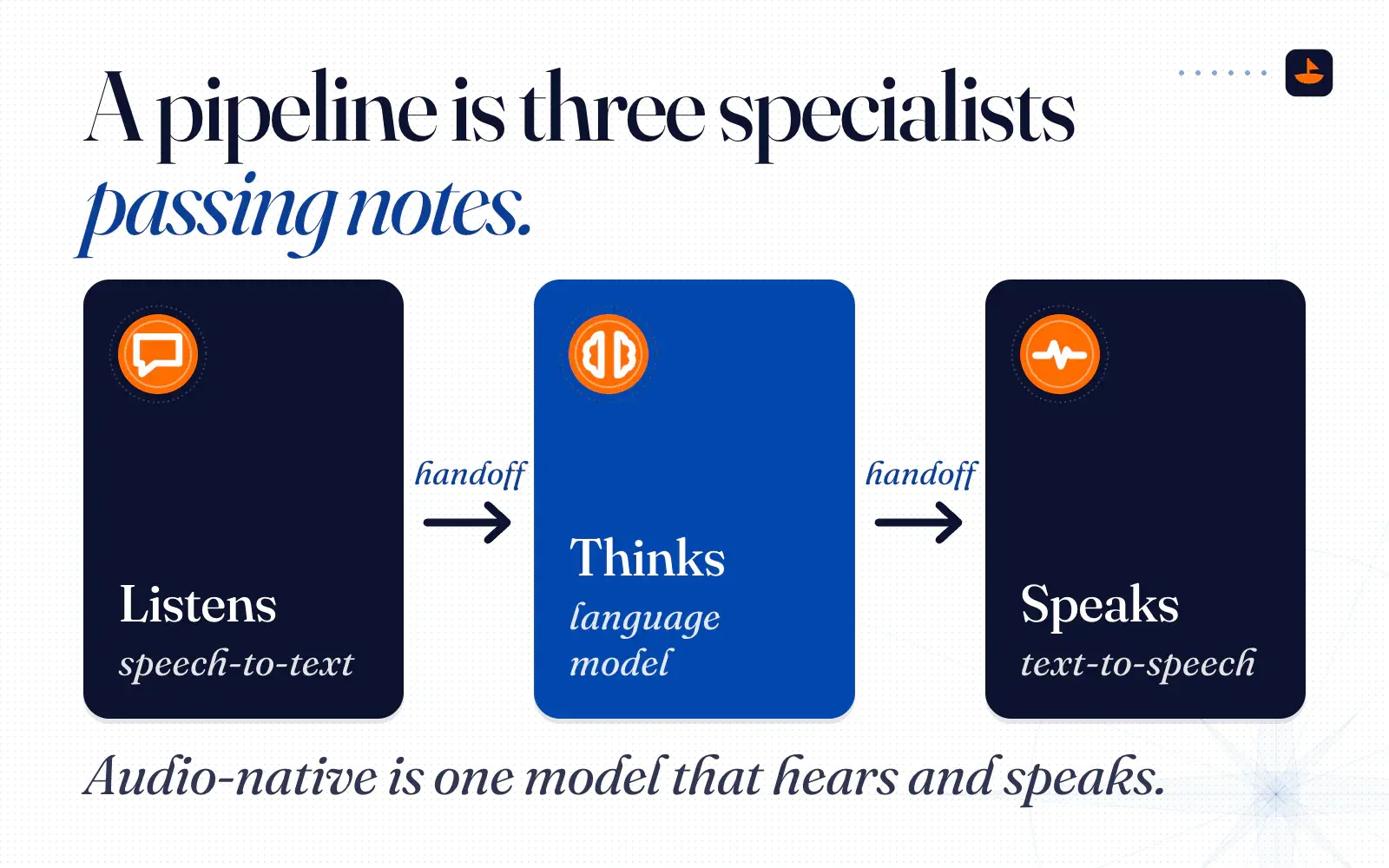
Here's the difference in plain terms. A pipeline is three specialists passing notes. One listens and types, one thinks, and one reads the answer aloud. Every handoff adds a little delay, and the one doing the thinking only ever sees the typed notes. An audio-native model, also called speech-to-speech, is a single model that hears the audio and speaks back. Nothing gets lost in transcription, and there are fewer places to wait.
Grok's newest voice model cost 8 cents a minute, flat, against his 15. My answer came fast. "Honestly, I think 15 cents compared to 8, like right off the bat, we were talking about margins is a no-brainer," I told him. With costs that low, "your pricing you can be way more generous on."
The timing mattered just as much. If he switched after launch, his users would already be used to one voice. "You also have the privilege of being in this pre-launch stage to change it," I said. "Timing-wise, it makes way more sense to make this type of dramatic decision now than later." The hardest part for him was the days he'd already spent tuning ElevenLabs voices, and I named it plainly: "The biggest one is the sunk cost fallacy of the time you put into the fine-tuning of the voices."
I had one question before he committed: "Does the Grok one have range? Does it have different styles and voices?" A cheaper voice only saves you money if it can still play every character you need. He didn't know yet, because the competitor's free trial only ever used one voice.
Then I said something that cuts against how hard I'd sold him on ElevenLabs a month earlier. Latency was "probably the biggest reason" to switch. "The faster it can talk to the user, the more realistic it's going to feel," I said. "Better than any super nuanced voiced machine could do."
He asked how big a job the switch would be. "At the end of the day, you're just swapping out a vendor," I told him. Most of his code would stay the same, and I'm "always in favor of consolidating vendors," because one vendor where you had two is "a great idea for speed, great idea for security." When Claude estimated the move would cost him weeks of persona tuning, I told him not to believe it. Claude tends to quote months, then weeks, and then finish the job in one sitting.
Ten days later the switch was done. It cost half as much, it ran smoother, and the latency was good. The trade-off was the cast. Grok gave him five voices, three female and two male, and he was stuck with a male voice he didn't like because there were only two. I told him what I thought the switch was worth: "You doubled your margins with that decision."
Stack three: OpenAI at 10 cents a minute
By mid-September he'd been fighting one problem for over a month. About half the turns coming back from Grok took three and a half seconds. He'd ruled out his own code and filed reports with xAI, and nothing changed.
So he asked Claude what else was out there, and Claude pointed him at OpenAI's voice models. By the time he told me, he'd already built it and tested it. "You didn't just consider it, you went through and built it, and it's better," I said. He loved it: lower latency, more realistic voices, even the sound of breathing. It raised his cost from 8 cents a minute to 10.
I asked him the question I'd ask about any upgrade: "But what does it get you?" Was the extra 2 cents a minute worth it? For him it was an easy yes. Then I asked about the brain behind the voice: "What about the reasoning and all that?" That part took real work. He went back to his old loop of test calls, sending the transcripts to Claude with the adjustments he wanted, and by his own account it wasn't finished but it was close.
A 2-cent rise also reopens pricing. He could raise his price, give fewer minutes per plan, or do both. My push was to price on the value the product creates, not on what it costs to run, and to prove that value with customer stories: get a happy customer on a call and let them say it. And if the only way to win is to be the cheapest, pick a different buyer, because "it's a race to the bottom."
So the option I'd flagged as the expensive one in July ended up 2 cents a minute above Grok, and it's the one he picked.
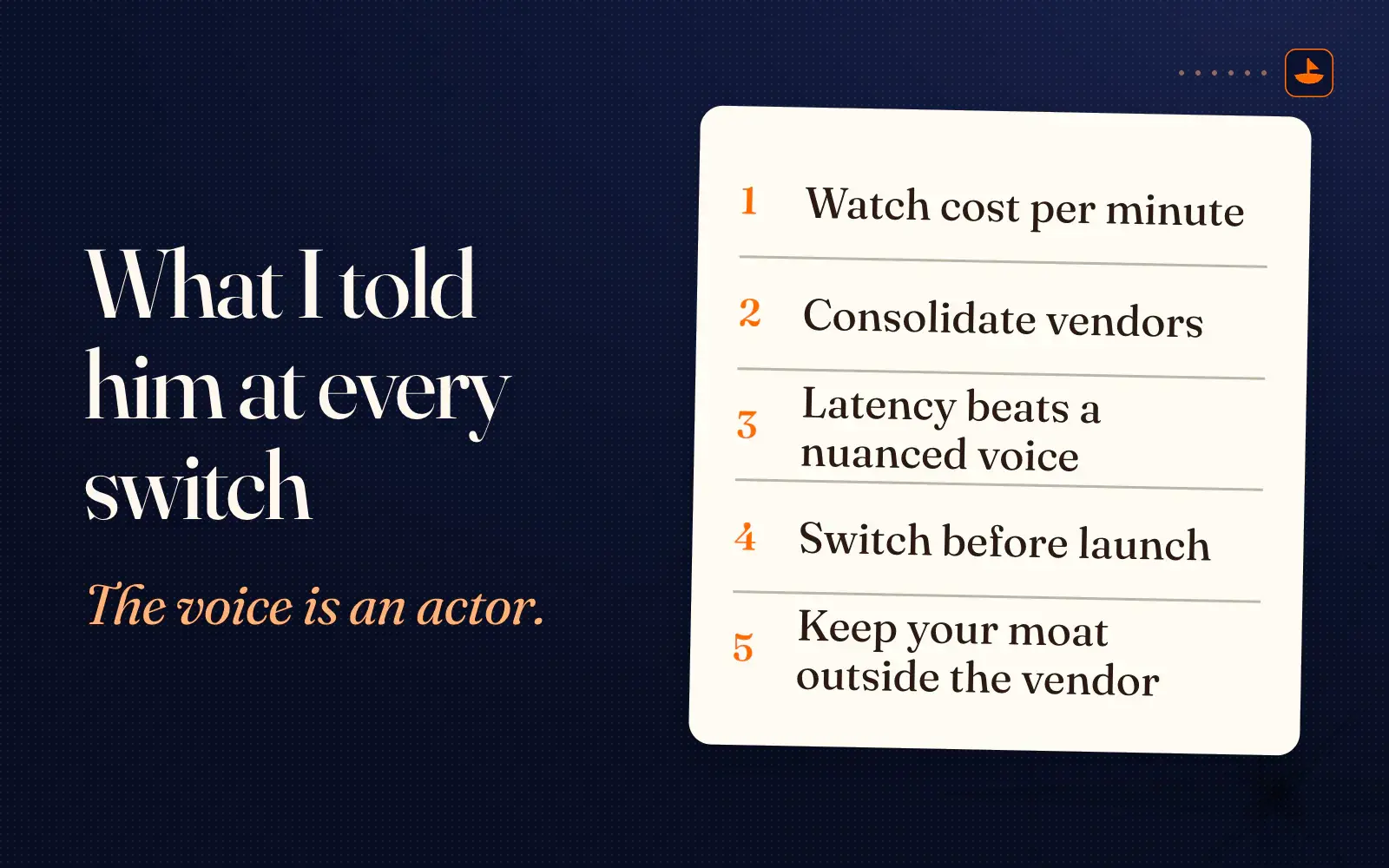
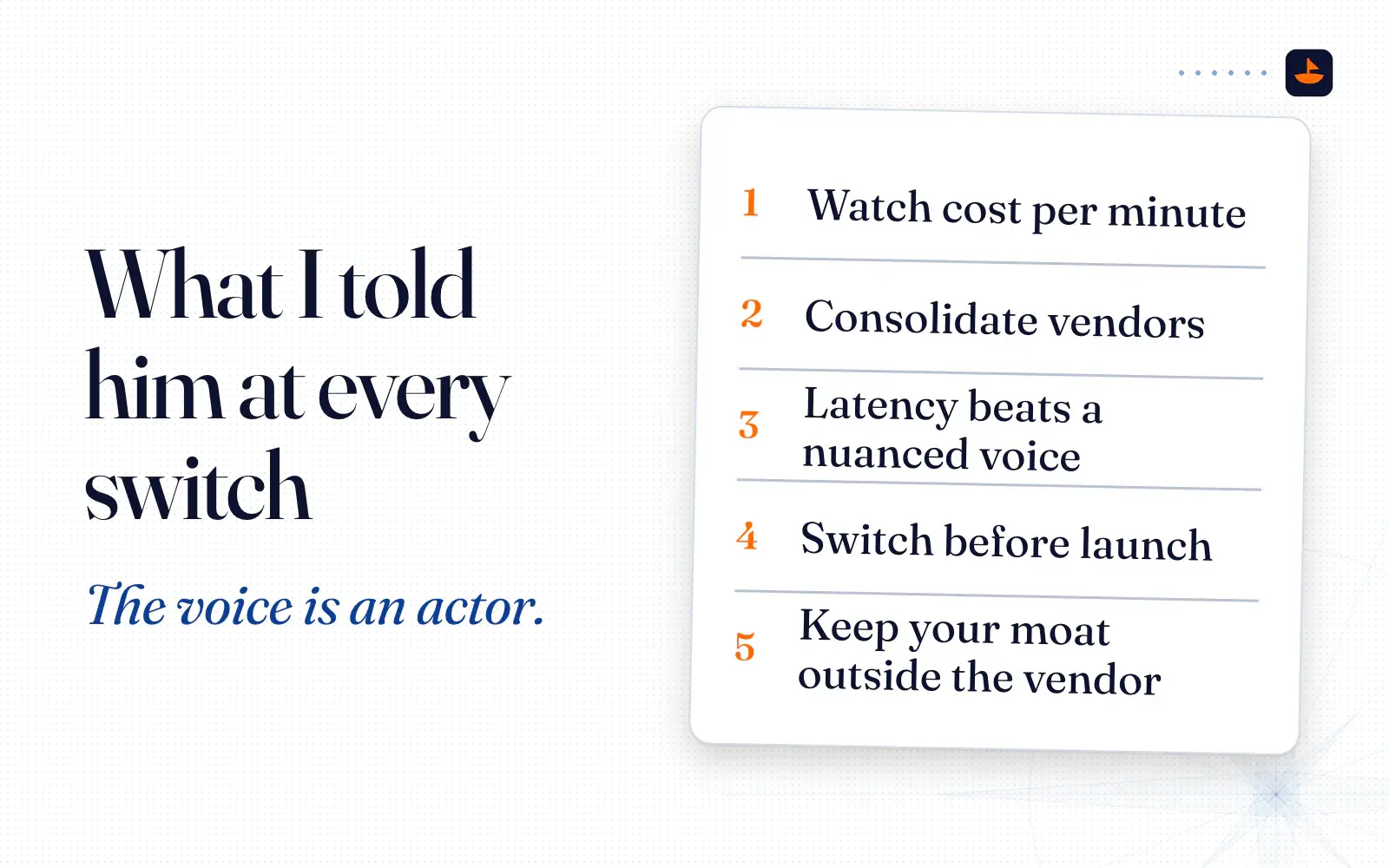
What I told him at every switch
- Cost per minute is the number to watch, not the only number. He paid 2 cents more a minute to get past the lag and get a more realistic voice, and the first thing I asked was what it bought him.
- Consolidate vendors. Fewer hops is better for speed, and fewer vendors is better for security.
- Latency beats a nuanced voice. The faster the AI answers, the more real it feels.
- Switch before launch. Each switch cost him days of work. None of them cost him users, because he hadn't launched yet.
- Keep your moat outside the vendor. The voice is an actor. His scenarios and personas belonged to him, not to Retell, xAI or OpenAI, so they came with him every time.
The grading problem
The voice is half of his product. The other half is the feedback users get afterwards. His first grader read the transcript, and tuning it took days of test calls, checking each transcript against its score and sending Claude screenshots whenever it misread something.
A transcript can only tell you what you said, though. It can't tell you how you said it. The competitor he admired used Gemini to grade the sound of the call, so it could comment on tone. When he asked me whether that was worth building, I said yes: "If it can know the difference between confidence and, like, hesitation, that's huge."
He also asked whether it was okay to copy a competitor's setup. "There's nothing wrong with copying the tools they provide," I told him. Almost every product is built from the same raw materials, and "it's how you put those raw materials together that sets you apart."
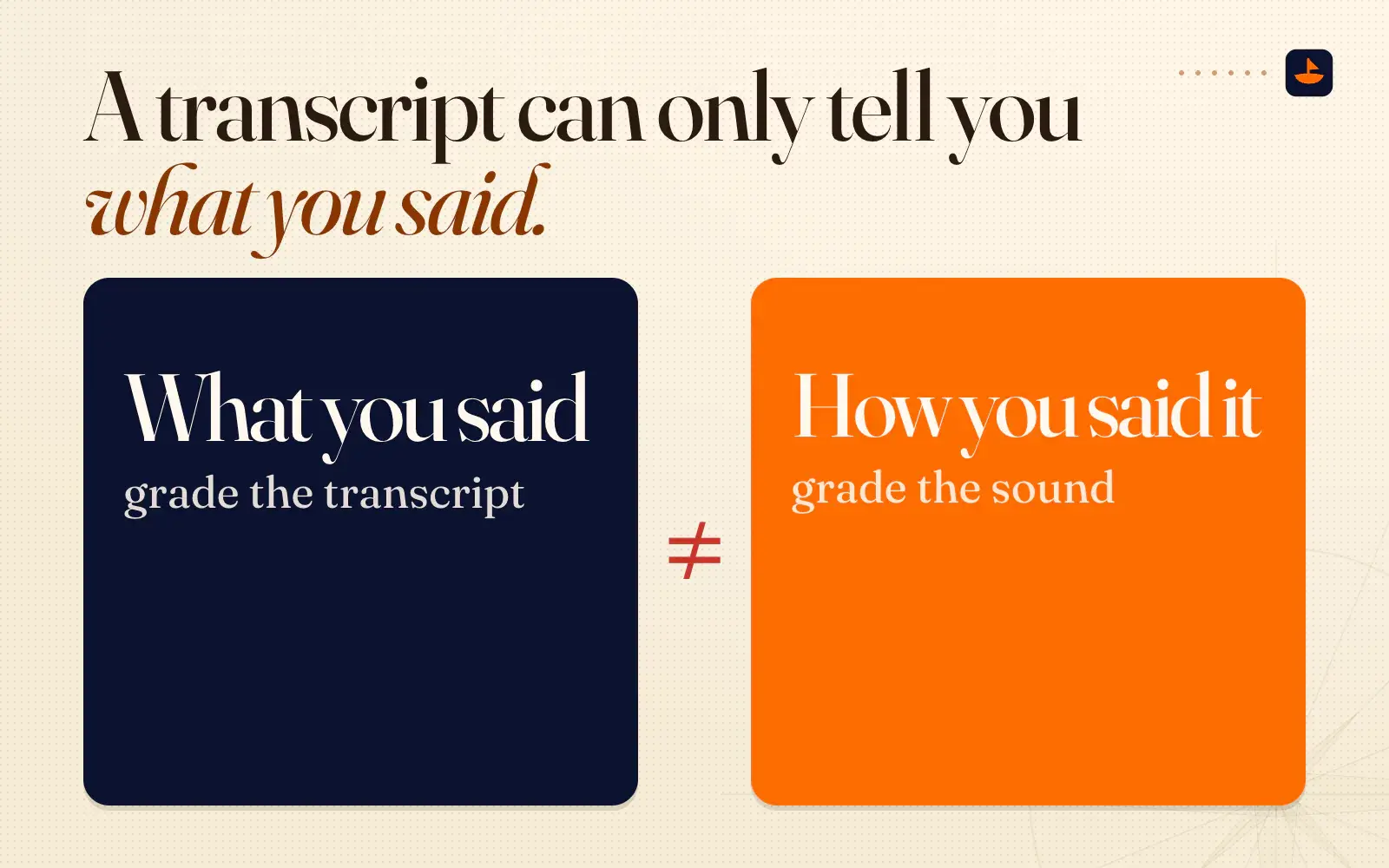
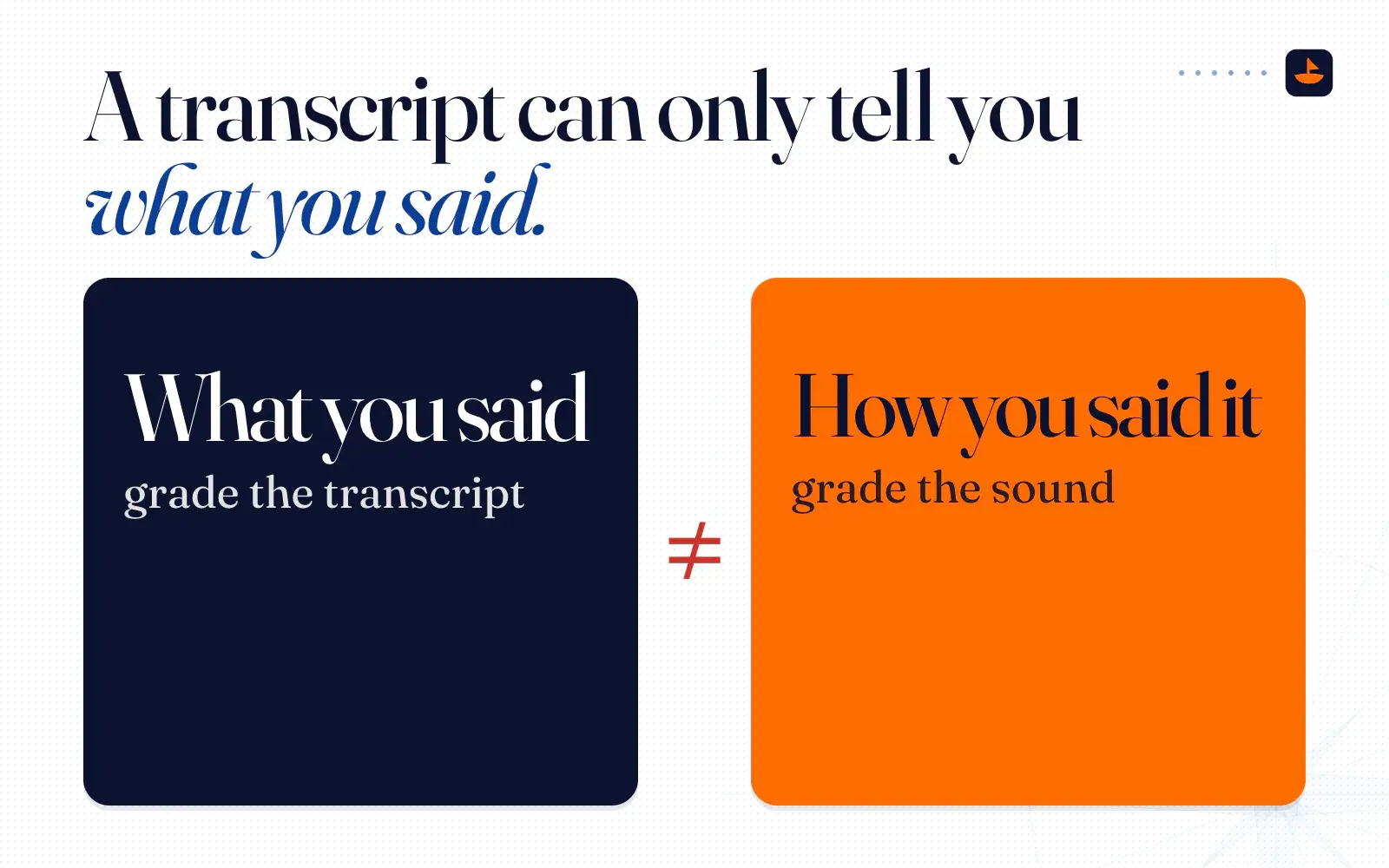
Grading the sound costs less than you'd guess. Google lists emotion detection among the things Gemini can do with an audio file, and it counts audio at 32 tokens a second. On Gemini 2.5 Flash, audio input costs $1 per million tokens, so the audio of a ten-minute call comes to about 2 cents before the written feedback. Modulate's Velma model labels 26 emotions across a recording, window by window, for 2 cents an hour of audio as a batch job. If you were planning on Hume, the company best known for emotion-aware voice, it's shutting down its EVI and text-to-speech APIs on November 13, 2026.
Before you launch
The last stretch of a voice product is tuning, and tuning is slow. I reminded him of an old software saying: "the first 80% of the build takes 20% of the time, and the last 20% takes 80% of the time." Here's the rest of what I'd tell anyone on the way to launch, most of it straight from our calls:
- Deploy early in the week. Putting a voice app online for the first time throws up "a lot of little friction points, not like big ones, a bunch of little ones." Start early enough to work through them with help on hand, not on a Friday.
- Lock down your keys. Never paste an API key into a chat, keep it in your platform's secrets, and set a monthly spend limit with the voice provider, so a leaked key can't drain your account. Once real users arrive, think about trading a hard stop for an alert, because a hard stop makes calls fail instead of overspending.
- Get free testers before paying customers. Two or three people who are excited to try it will help you fix the landing page, the copy and the first price, and at this stage they're worth more than ad spend or a big launch event.
- Don't chase every browser. He lost days to long silences that turned out to be Microsoft Edge throttling the page to save battery, not his code. My advice was to stop there: flag Edge, recommend Chrome, and remember how many tools already ask you to do that.
Then the hard part changes. Once the voice worked, I told him he'd "proven you can build anything that you set your mind to," which meant "building is not that constraint" anymore. The next constraint is getting the product in front of people, and no voice model solves that one for you.
The field, November 2026
Here's how the main options stand. I checked every price below on November 1, 2026, and they change often, so check again before you build. Two terms carry the whole table. A pipeline chains separate speech-to-text, a language model and text-to-speech. Audio-native, or speech-to-speech, is one model that hears and speaks. For audio-native models, the latency column is Artificial Analysis's independent measurement of time to first audio. For pipelines, latency depends on the parts you pick.
| How it works | Price per minute | First audio | Voices and cloning | Tone and emotion | Phone calls | |
|---|---|---|---|---|---|---|
| OpenAI GPT-Realtime-2.1 | Audio-native | $32 in, $64 out per million audio tokens. About 4.8¢ for a 50/50 minute, more as the call grows | 1.21 s (high reasoning), 0.97 s (minimal) | 10 built-in. Cloning from recordings for eligible customers | Hears the caller's audio directly | SIP, bring your own trunk |
| OpenAI GPT-Realtime-2.1 mini | Audio-native | $10 in, $20 out per million. About 1.5¢ for a 50/50 minute | 0.85 s (minimal) | Same 10 | Hears the caller's audio directly | SIP, bring your own trunk |
| OpenAI GPT-Live-1 | Full-duplex voice model that hands the thinking to a backend model you pick | 5¢ plus the backend model | 1.24 to 1.34 s | Design a voice from a text prompt, free for all API customers | Hears the caller's audio directly | SIP, plus Twilio, Telnyx, Bandwidth, LiveKit and Daily/Pipecat guides |
| xAI Grok Voice 3.0 | Audio-native | 8¢ flat | 0.81 s | Built-in set (five when tested in August). Clone from a short clip | Hears the caller's audio directly | SIP, WebSocket or LiveKit |
| Google Gemini 3.8 Live | Audio-native | 0.5¢ in, 1.8¢ out. About 1.4¢ for a 50/50 minute | 1.18 s | 30 prebuilt voices | Affective dialog adapts its style to the caller's expression and tone | Not covered in the docs |
| ElevenLabs Agents | Pipeline with its own speech recognition and turn-taking. Optional Realtime speech-to-speech models | 8¢ plus the language model | 0.57 s (Realtime v1 Max) | 10,000+ voices. Instant cloning from Starter, professional from Creator | Depends on the voice model | Twilio and SIP, telephony included |
| Retell | Pipeline you configure | 7¢ to 31¢. About 11¢ in a typical setup | Depends on parts | Retell, ElevenLabs, Cartesia, OpenAI and other voices | Depends on the voice | Numbers at 1.5¢ a minute, SIP free |
| Vapi | Pipeline you assemble | 5¢ hosting plus providers at cost. 8.2¢ to 12.9¢ in Vapi's calculator | Depends on parts | Whichever voice provider you pick | Depends on the voice | Vapi numbers and SIP free, carrier extra |
| Deepgram Voice Agent | Pipeline in one API | 7.5¢ bundled, 5¢ if you bring your own model and voice | Depends on parts | Deepgram voices or your own | Not covered | Not covered |
| Cartesia agents | Managed pipeline | 3¢ plus the language model, 1.4¢ more on a Cartesia number | Under 90 ms for its Sonic voice alone (vendor claim) | Clone from 10 seconds of audio, Pro and up | Sonic reads the emotional context of the text | Cartesia numbers |
Per-minute figures for token-priced OpenAI models are my arithmetic. OpenAI counts the caller's audio at 1 token per 100 milliseconds and its own speech at 1 token per 50 milliseconds, and it re-sends the whole conversation on every turn, so later turns cost more. "50/50" means the caller and the AI each talk for half the minute. Google publishes per-minute figures for Gemini Live, and I count its input for the whole minute and its output for half. The typical Retell setup is Retell's infrastructure at 5.5¢, a 1.5¢ voice, GPT 5.4 mini at 2.4¢ and a 1.5¢ US phone line.
OpenAI now has two voice lines. The Realtime models, GPT-Realtime-2.1 and a cheaper mini, came out on July 6 and bill by the audio token. GPT-Live-1 became generally available on September 10. It bills 5 cents a minute and hands the reasoning and tools to a backend model you choose and pay for separately. Since October 16, any API customer can design a GPT-Live voice from a text description.
xAI shipped Grok Voice 3.0 in October at the same 8 cents a minute as Grok Voice 2.0. It has also supported custom voices, cloned from a short clip, since May. Artificial Analysis measures Grok Voice 3.0 at 0.81 seconds to first audio, faster than GPT-Realtime-2.1, GPT-Live-1 or Gemini 3.8 Live in its table. The founder's lag was on the summer model, and I haven't seen a retest on 3.0.
Google published Gemini 3.8 Live on September 15. It has 30 prebuilt voices and an affective dialog setting that lets it adapt its style to the caller's expression and tone, and it's one of the two cheapest audio-native options I priced, alongside GPT-Realtime-2.1 mini. The docs say affective dialog isn't supported on Gemini 3.1 Flash Live, and they don't cover phone lines, so you'd bring your own bridge.
ElevenLabs still has the deepest voice catalog, with more than 10,000 voices. Its Agents platform runs a pipeline with its own speech recognition and a turn-taking model, at 8 cents a minute plus the language model, with telephony included. It now also offers Realtime speech-to-speech models, and Artificial Analysis clocks the larger one at 0.57 seconds to first audio.
Retell and Vapi are the assembly kits. Retell lists 7 to 31 cents a minute depending on the parts, and ElevenLabs voices cost 4 to 10 cents a minute there instead of 1.5. Vapi charges 5 cents a minute for hosting and passes model costs through at cost. Both come with phone numbers and SIP built in.
Deepgram's Voice Agent API bundles speech-to-text, a managed language model and text-to-speech into one 7.5-cent rate over a single connection. Cartesia charges 3 cents a minute for its agents plus the language model, and says its Sonic voice delivers first audio in under 90 milliseconds and clones a voice from 10 seconds of audio.
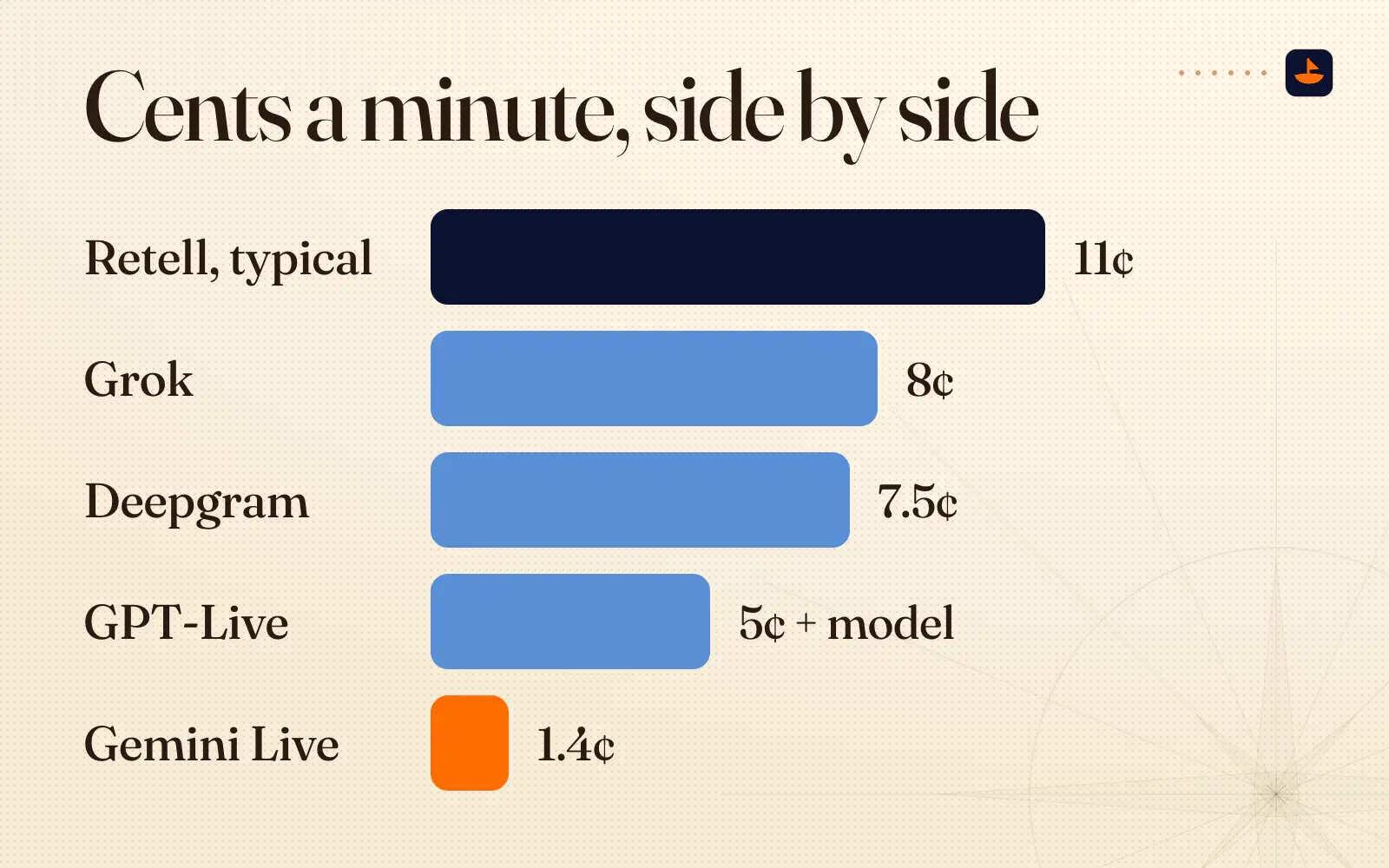
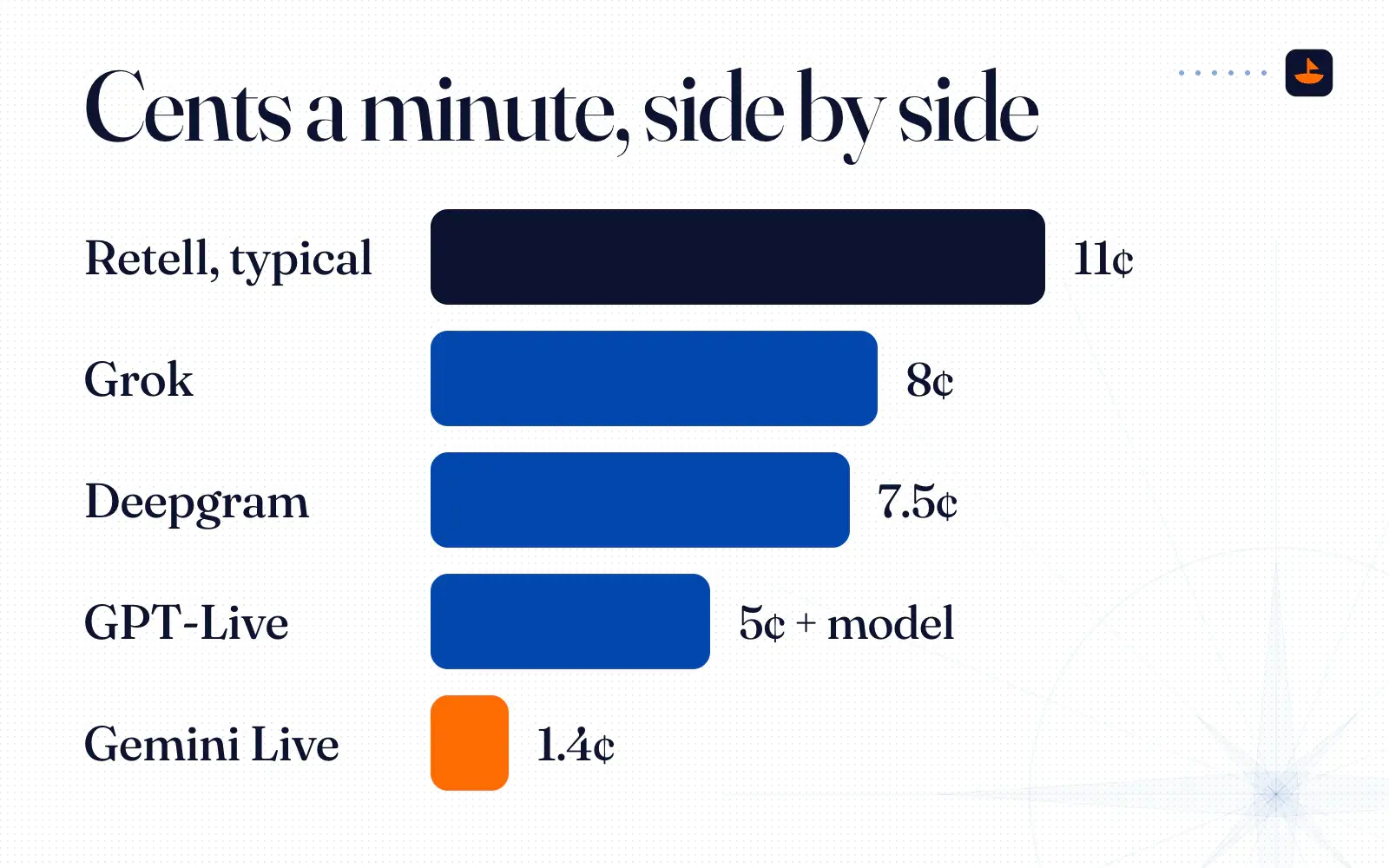
Put side by side, a typical Retell setup runs about 11 cents a minute, Grok 8 cents, ElevenLabs Agents 8 cents plus the model, Deepgram 7.5 cents, GPT-Live 5 cents plus the model, and Gemini 3.8 Live about 1.4 cents.
Which one should you pick?
Here's the advice I gave him, applied to the field as it stands today:
- Before anything else: open free accounts and run your own script through two or three options. That was my first advice in July, and it still beats any table, this one included.
- An app where people talk to an AI in the browser: start audio-native. That's where he landed, and it's where the low latency and the low per-minute prices are. Run your own scripts through GPT-Realtime-2.1 or its mini, Grok Voice 3.0 and Gemini 3.8 Live before you pick, and check each voice list against the cast you need.
- A specific voice, a cloned brand voice or a big cast of characters: ElevenLabs, for the 10,000-plus voices and cloning from its Starter plan. Cartesia also clones from 10 seconds of audio.
- Phone calls at scale, inbound or outbound: Retell or Vapi, which come with numbers and SIP built in, or ElevenLabs Agents, which includes telephony. OpenAI and xAI take SIP too, but you bring the trunk.
- Predictable unit costs: a flat rate, like Grok's 8 cents, Deepgram's 7.5 cents bundled, or GPT-Live's 5 cents plus your model. Token-priced models cost more per minute as a call runs long.
- Grading how someone sounds: send the recording to an audio model after the call, like Gemini's audio understanding at about 2 cents for a ten-minute call, or Modulate's batch emotion detection. Don't build on Hume's EVI, which shuts down on November 13.
- Whatever you pick: test in the browsers your users use, at the call lengths they'll run, before you blame the vendor for a delay.
The short version
Price voice AI per minute, all in, because that's the number your margins live on. Use the fewest vendors that do the job. Test latency on real calls before you fall for a voice. Make big switches before launch, while nobody is used to the old one. And keep the thing that took you longest to build, like your scenarios, your personas and your grading rubric, outside any one vendor, so the next switch is a swap and not a rebuild.
I post what I'm building on X @PalafoxPalmer.
Sources
- API pricing: realtime and audio models
- Managing costs and latency for voice
- API changelog
- Realtime conversations
- Custom voices
- GPT-Live
- SIP for voice
- OpenAI’s Realtime API launch
More sources
- Pricing: voice
- Release notes
- Voice agent
- Quickstart
- X API pricing
- Gemini API pricing
- Gemini 3.8 Audio model card
- Live API capabilities guide
- Speech generation
- Audio understanding
- ElevenLabs Agents pricing
- ElevenAgents overview
- ElevenLabs pricing
- Retell pricing
- Vapi pricing
- Deepgram pricing
- Cartesia pricing
- Sonic
- Speech to speech leaderboard
- EVI overview
- Modulate pricing