Essay · Silicon and Succession · 02
Apple's Only AI Play Is Private Compute
On August 25 I said Apple had lost the frontier AI race and would answer with a Mac Studio built for private AI, at around $25,000. Two months later the price is in. Here is the bet, what landed, and the strongest case against it.
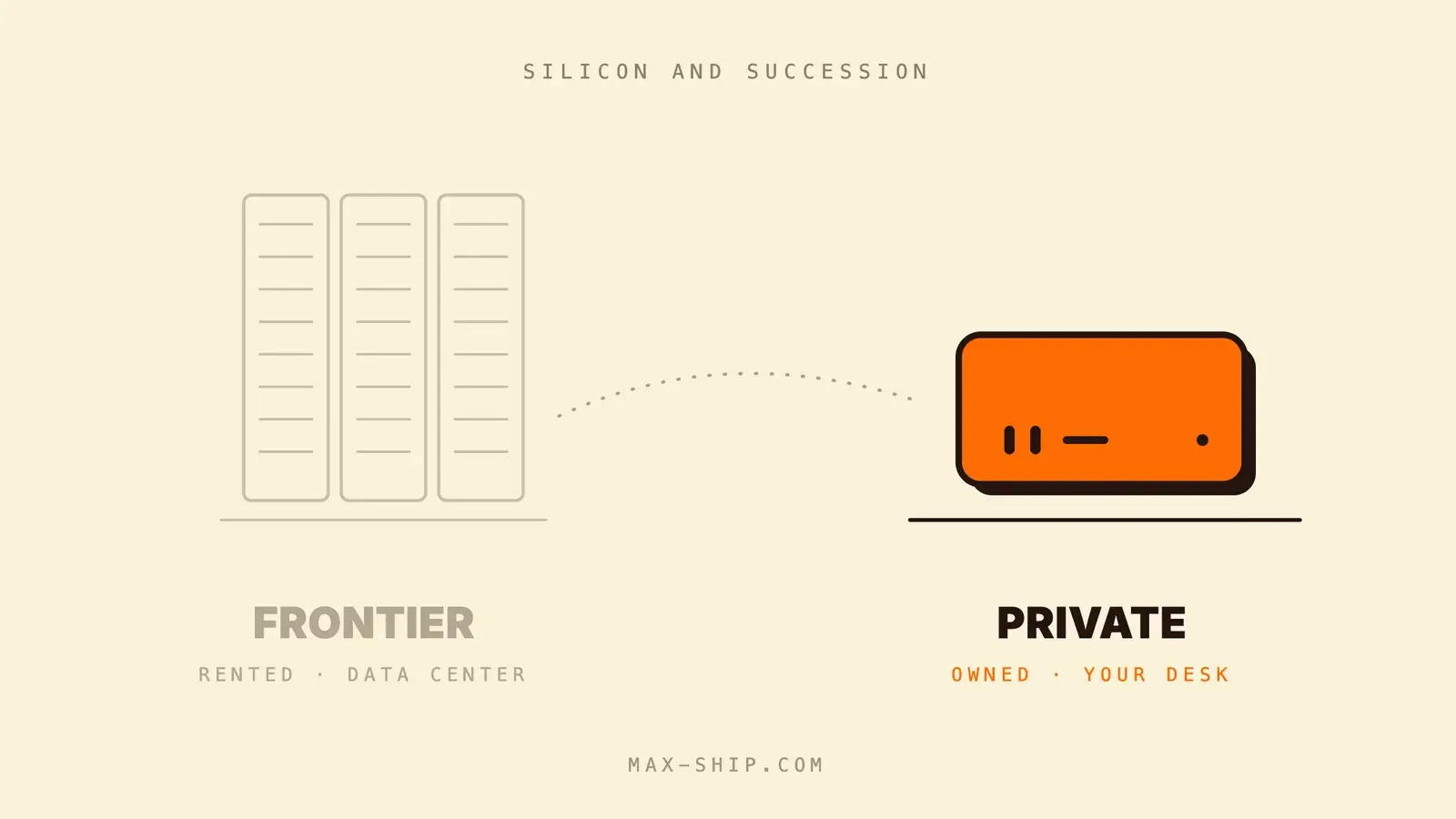
I ended part one on a question. What does a product-driven Apple do with a $4 trillion balance sheet and the best silicon on earth, at the exact moment the entire industry is deciding where thinking is going to happen?
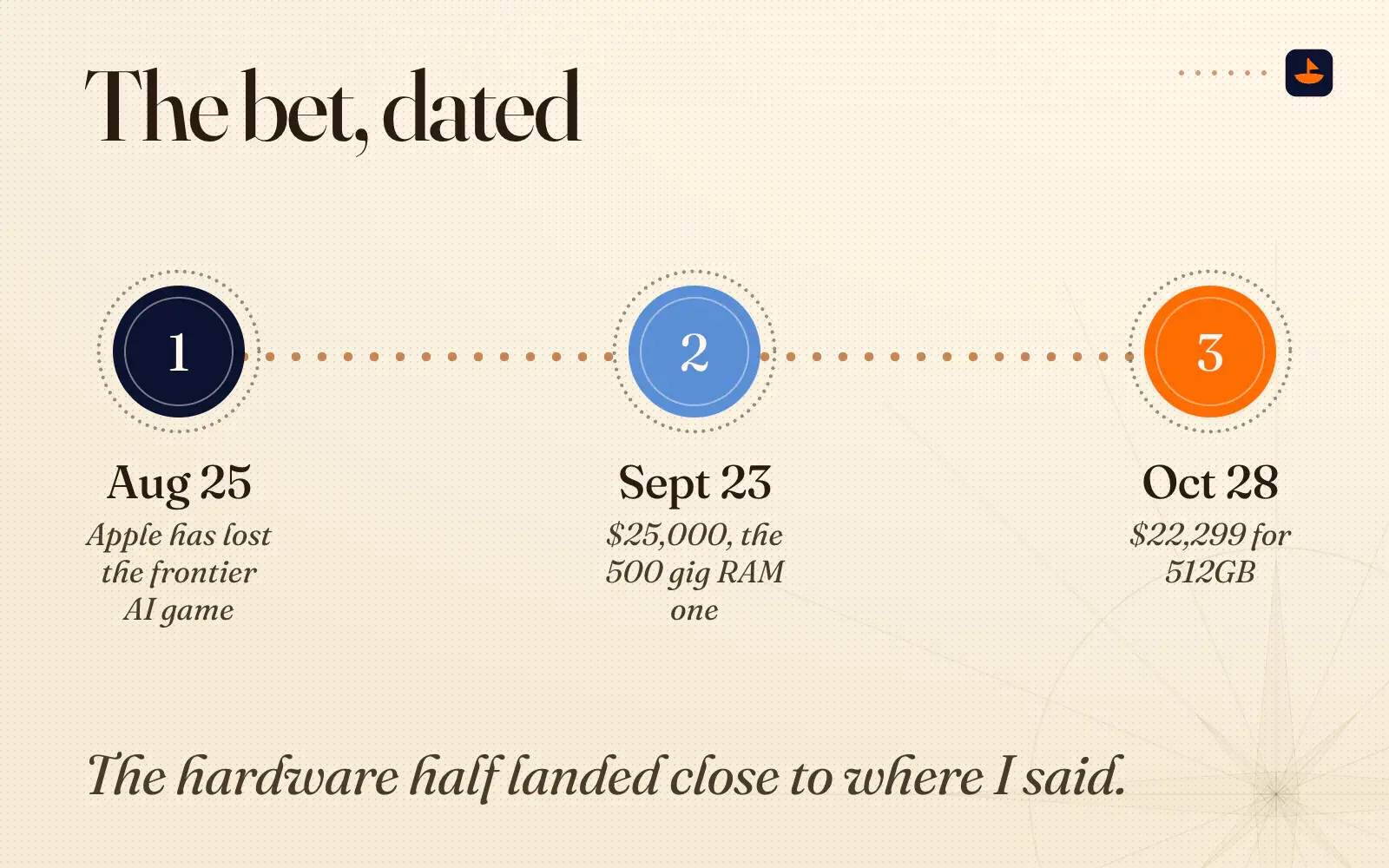
I already had my answer, and I said it out loud on August 25, 2026, a week before John Ternus took over as CEO. I wasn't writing an essay. I was thinking out loud on a call about running AI locally, so it isn't polished, but it is dated:
"Apple has lost the frontier AI game. Instead of what every business is doing right now, which is send everything to the AI companies and just hope they can be trusted with it, I think Apple's only play here is... I think they're going to come out with like a $25,000 Mac Studio."
I added that I thought Apple would "go hard into that" and get behind "the idea of hosting your own local models."
That same day, Apple announced a new Mac Studio with M5 Max and M5 Ultra and called it "the ultimate desktop for on-device AI." The top memory option, 512GB, was "coming in late October," with no price yet. On September 23 I put a number and a month on it again: "that $25,000 one... the 500 gig RAM one. That comes out in October."
On October 28, Apple opened orders for the 512GB configuration. You start from the top M5 Ultra at $6,799 and add $15,500 for the memory, which makes the cheapest 512GB Mac Studio $22,299. Max out the storage at 16TB and it costs $29,799. My guess on August 25 was about $25,000.
So the hardware half of the bet landed close to where I said it would. The other half is the one that matters: that private compute is Apple's only real AI play, and that a machine you own can take over a real share of the work we now send to data centers. That half is still open, and the best evidence against it comes from Apple, and from me.
I ran it on a laptop first
My first real taste of local AI was OpenClaw, the open-source personal agent that started life as Clawdbot. I ran the whole thing off my M4 MacBook Pro, which has 64GB of memory, with a Qwen model doing the thinking on the back end.
It was "enough to give me a taste of, there's something huge here," as I said on that August call. Not for hard reasoning. "I'm talking organizing, librarian work, schema organizing, you know, like project tagging." The quiet back-office work, done by a model that lived on my own laptop.
It also had a cost you could feel. My notes from a February setup session say local models running through Ollama were causing memory spikes of around 60GB, on a machine with 64. By default, Ollama keeps a model loaded for five minutes after you last use it, so the memory doesn't come back the moment you stop. The note ends with the decision: stick with cloud APIs.
Local isn't automatically safe, either. In February, a security audit of 2,857 skills on ClawHub, the marketplace for OpenClaw add-ons, found 341 malicious ones. Most of them tricked people into installing a macOS info-stealer called Atomic Stealer. A model on your own machine is only as private as everything else you let onto it.
So I moved. Anthropic was being generous with Claude credits, and in my own words from that call: "I just got better value by switching to a frontier model, and I definitely knew I compromised on my security once I did that."
That's the whole argument in miniature. The local model was good enough for the librarian work. The frontier model was better and cheaper for me at the time, and the price was my data leaving my desk.
Where Apple actually stands
Here is Apple's AI position as of November 1, 2026, in Apple's own words wherever I could find them.
Apple didn't build its own frontier model. In January, Apple and Google announced that "the next generation of Apple Foundation Models will be based on Google's Gemini models and cloud technology." Bloomberg reported the price at about $1 billion a year. In June, Apple described the result as "a family of five foundation models custom-built in collaboration with Google." The new Siri, called Siri AI, started rolling out in beta, in English, on September 14.
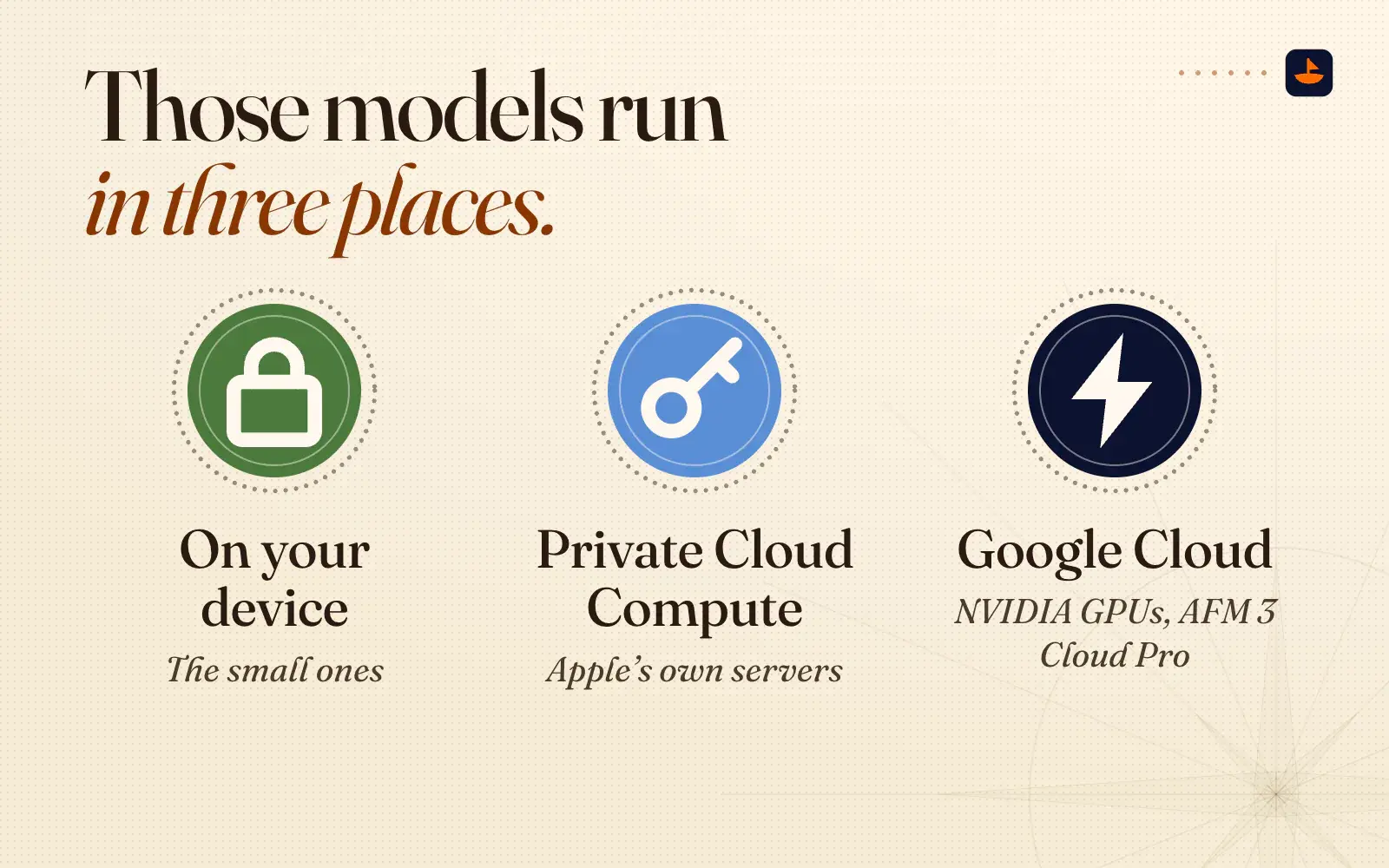
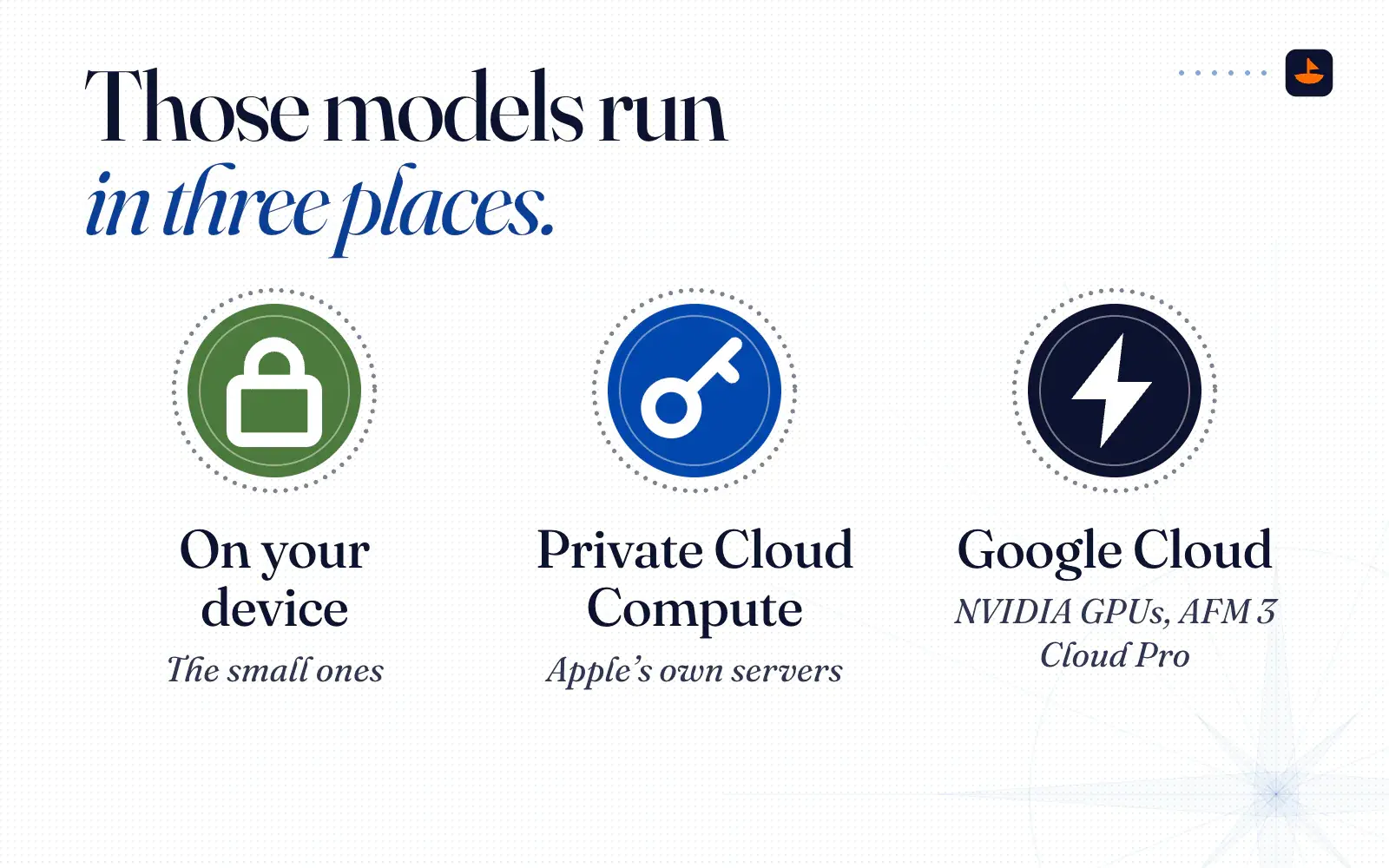
Those models run in three places. The small ones run on your device: a 3-billion-parameter model, and a 20-billion-parameter model that only uses 1 to 4 billion of its parameters at a time. Bigger requests go to Private Cloud Compute, Apple's own servers. The biggest model, AFM 3 Cloud Pro, runs on NVIDIA GPUs in Google Cloud, which Apple says it brought under the same Private Cloud Compute rules.
Private Cloud Compute is the part I keep coming back to. Apple published the design in 2024. Your personal data is used to answer the request and then it's gone: it "must not be retained, including via logging or for debugging." Apple's own staff get no privileged access to the running system, and security researchers can check that the software matches the promise. In June 2026 Apple extended those commitments "to third-party data centers for the first time," and said the protections on Google Cloud would be "gradually ramping" through the summer.
Even Apple's servers are metered. Features that rely on server-side models, Siri AI included, come with daily usage limits, and Apple says expanded access "will be available for a fee in the future."
Then look at the spending. Apple's capital expenditures in fiscal 2025 came to about $12.7 billion. Microsoft, Alphabet, Meta and Amazon together spent more than $400 billion on the same line in calendar 2025, as The Motley Fool tallied it. Apple didn't try to outbuild them.
That's what I meant on August 25. Apple lost the race to build the biggest model, so it competes on where the model runs and who gets to see your data. Private compute is the play.
What $22,299 buys
The Mac Studio is the other half of that play: private compute you own outright.
The M5 Ultra version goes up to a 36-core CPU, an 80-core GPU, and 512GB of unified memory with 1.2TB/s of bandwidth, "enabling users to run enormous LLMs entirely on device," in Apple's words. Unified memory is the trick. The GPU can use most of that 512GB for a model, where a graphics card is limited to the memory on the card. You can also cable up to four Mac Studios together over Thunderbolt 5, and Apple pitches that for "the largest and most demanding frontier-class open-weight models available today."
So what fits? On October 15, Meta released Muse Spark Open, an open-weight model with 816 billion parameters that Meta calls its "most capable U.S. open-weight model to date," and worked with Apple so it runs on two 512GB M5 Ultra Mac Studios. John Ternus posted: "Amazing to run a model of Muse Spark Open's caliber and scale this efficiently, right from your desk." Two machines at $22,299 each comes to $44,598 before tax, for a model that runs entirely on hardware you own.
The previous generation already showed the shape of it. The 2025 Mac Studio with M3 Ultra also topped out at 512GB, and in Dave Lee's testing it ran a 4-bit version of DeepSeek R1, a 671 billion parameter model, at about 17 to 18 tokens per second while drawing under 200 watts.
At the other end, the librarian work I did on my laptop needs far less. In Ollama, the 8-billion-parameter Qwen3 model is a 5.2GB download and the 30-billion-parameter one is 19GB. Those fit on a good laptop with room to spare.
The case against me
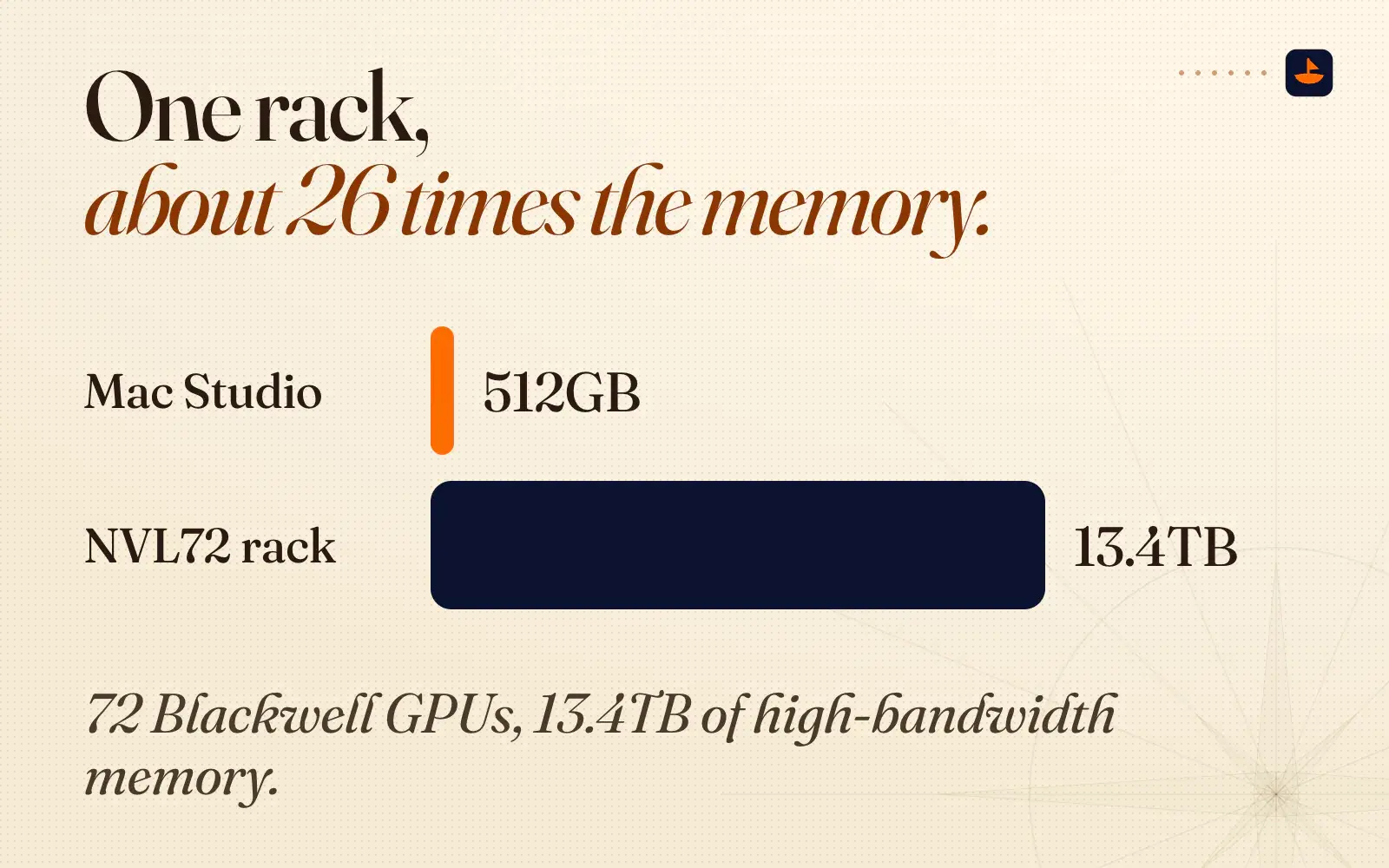
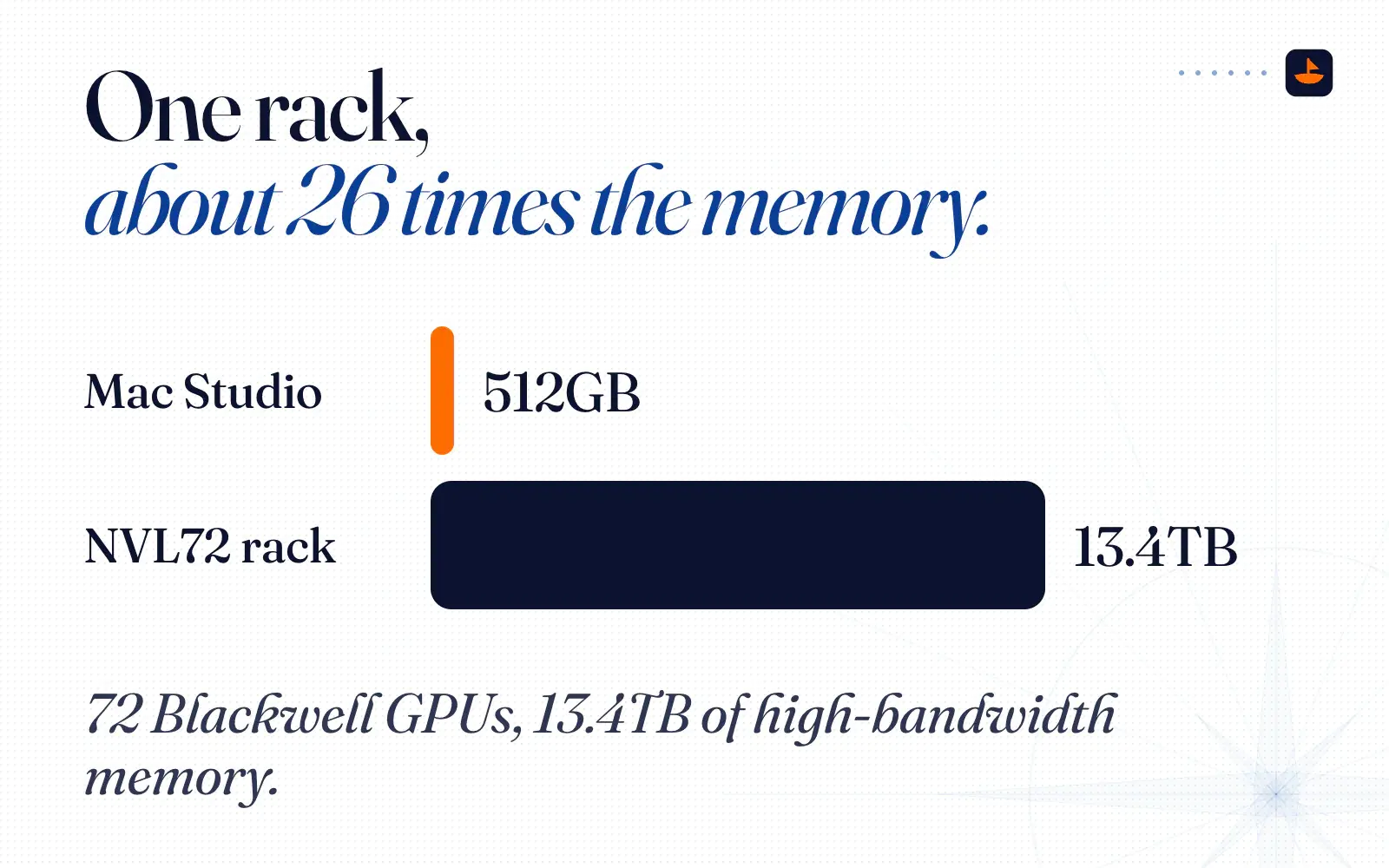
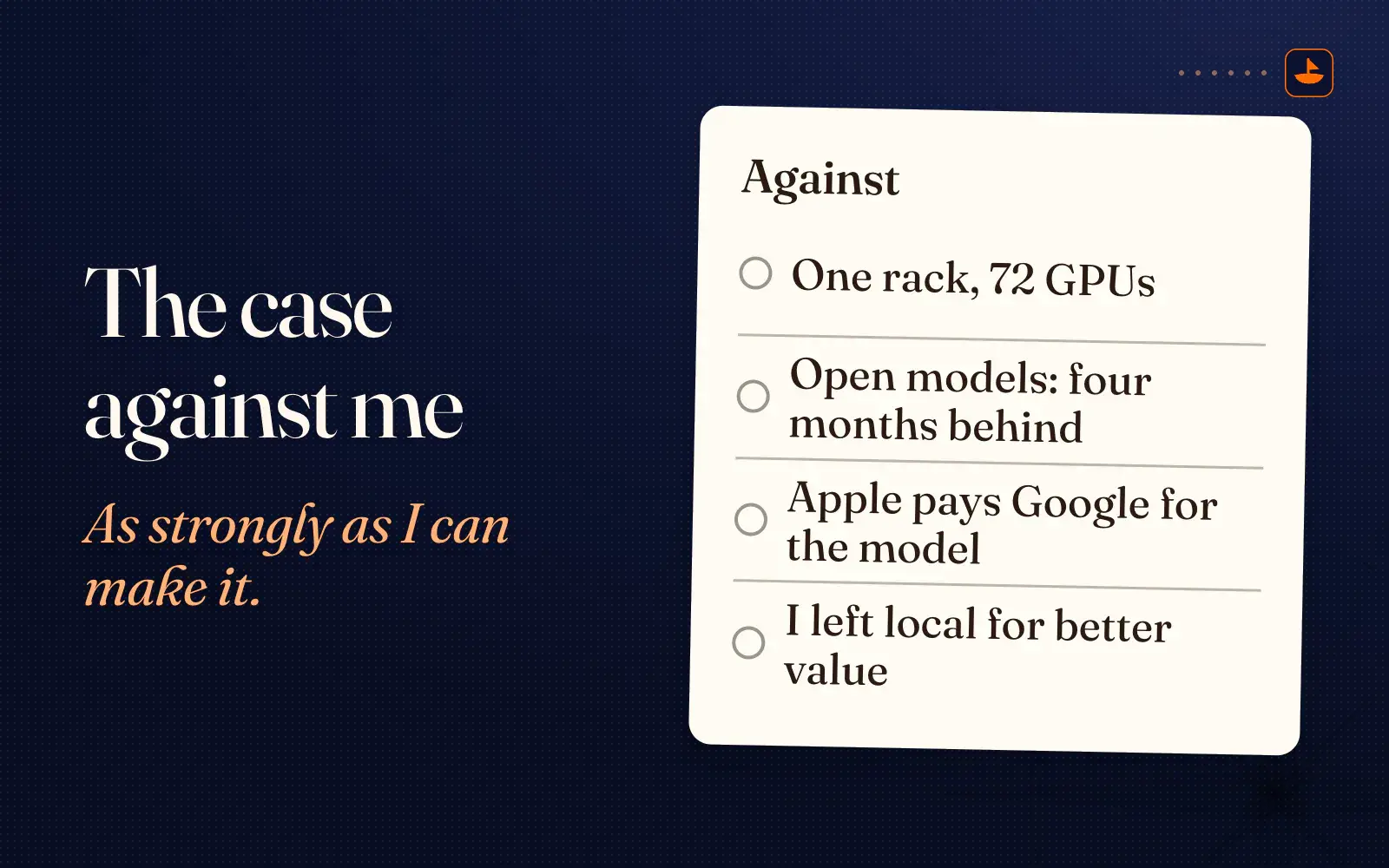
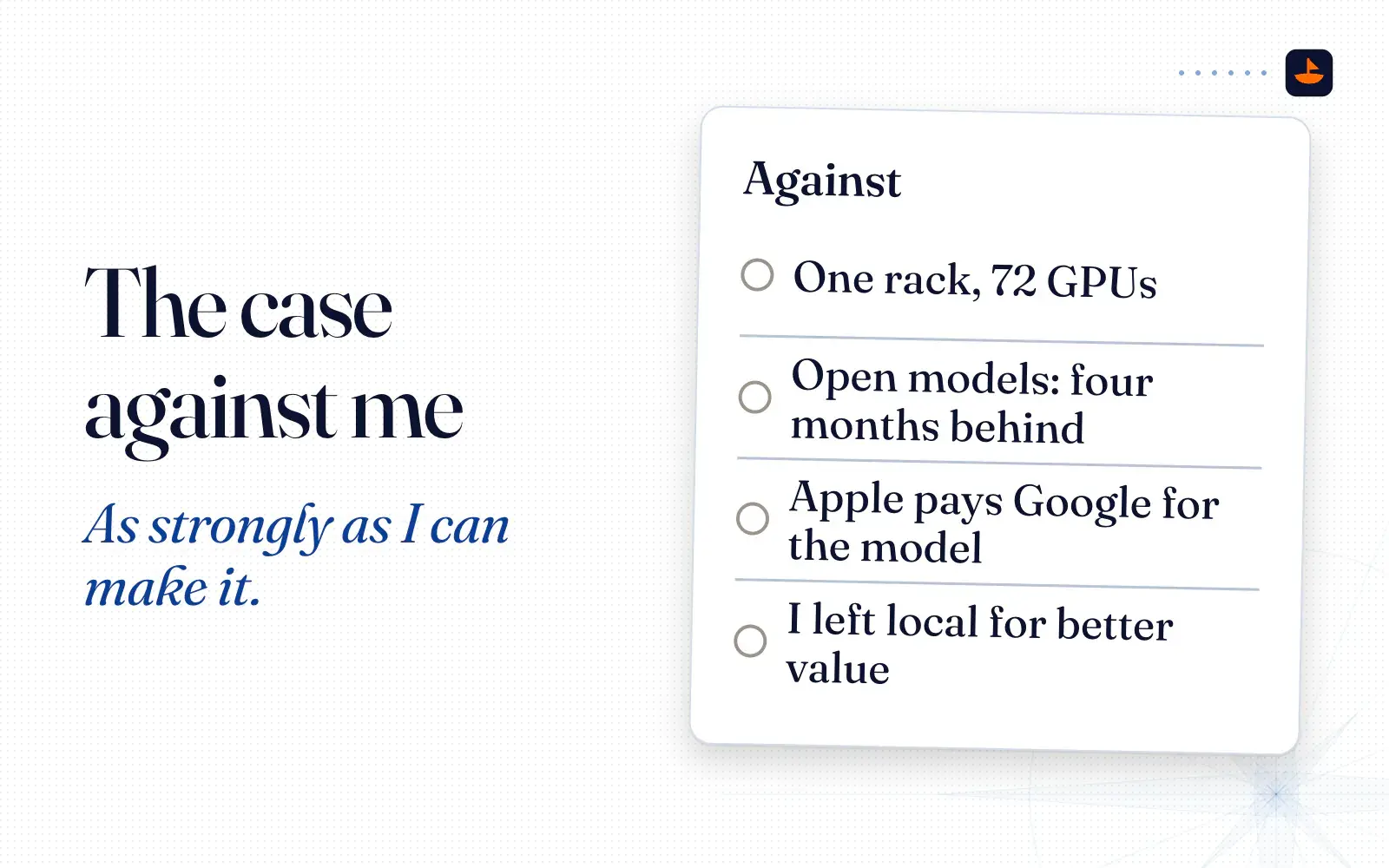
Here is the counterargument, as strongly as I can make it. Frontier models don't run on one box on a desk. They run across many high-end GPUs. One NVIDIA GB200 NVL72 rack connects 72 Blackwell GPUs with 13.4TB of high-bandwidth memory and 576TB/s of memory bandwidth. A maxed Mac Studio has 512GB and 1.2TB/s. By my math, one rack has about 26 times the memory and 480 times the bandwidth.
Open models are getting better by the week, as I said back in August, but they are still behind. Epoch AI found that since January 2026 the most capable open-weight models have lagged frontier closed models by an average of four months.
Apple itself is the strongest piece of evidence. The company with the best consumer silicon on earth sends its hardest requests to NVIDIA GPUs in Google Cloud, and pays Google for the model underneath. If local were enough, the counterargument goes, Apple would be the first to say so.
And then there's me. I had a working local setup and I left it for a frontier model, because the frontier model was the better value. The counterargument says most people and most businesses will make the same trade I did, every time the cloud is better and cheaper.
Why I'm still making the bet
I don't think the answer is local or cloud. On September 23 I said it "should be both. When necessary," and that "we'll be cheating and using the frontier models to get ourselves there." The frontier models get you there. Private compute is where you want to end up.
Then there's the economics. "You don't pay for tokens" was how I put it that day. A cloud model bills you for every word it reads and writes. A machine in your closet costs what it costs once, plus power. "One of my big beliefs is I think we won't need the data centers," I said, "if you have the money to pay for it." The second half of that sentence matters. $22,299 is a car.
When I talked to the founder of Screenpipe in October, he described the same split I keep landing on. He pictured a future where "every single home has like a local compute, local AI," with "a cloud AI for more complex tasks, but a lot of things will be handled by smaller models." I told him I'm excited for Sam Altman and OpenAI and everything they're doing, "but I don't think the big data center is the only way to go."
That's the bet. Local private compute does the librarian work and the private work, the frontier models in the data centers handle the hardest problems, and the line between them keeps moving as the open models catch up.
Where the bet stands
Here's where it stands on November 1, 2026. Apple's top model is built with Google and runs on NVIDIA GPUs. A hardware-first CEO is in charge, and he's posting about running an 816 billion parameter model from a desk. The Mac Studio for private AI shipped at $22,299 to $29,799. What's still open is whether private compute turns out to be Apple's whole answer, or only the part of the answer Apple is best at.
On August 25 I also said that if Apple came out with a "$25,000 super AI, local development, private, secure" Studio, I'd be waking up at 1 a.m. "to wait in line for a car's worth of a Mac. Like, we're back, baby."
Apple came out with it.
If you want to argue with me about any of this, reach out. I am always happy to get into it.
Sources
- Apple introduces new Mac Studio with M5 Max and M5 Ultra,
- Mac Studio With M5 Ultra Now Available With 512GB RAM for $22,299,
- Buy Mac Studio
- Tim Cook to become Apple Executive Chairman, John Ternus to become Apple CEO,
- Joint statement from Google and Apple,
- Apple to pay Google about $1 billion a year for Siri model
- Introducing the third generation of Apple Foundation Models,
- Private Cloud Compute: A new frontier for AI privacy in the cloud,
More sources
- Expanding Private Cloud Compute,
- Siri AI, a profoundly more capable and personal assistant, is here,
- Apple debuts iPhone 18 Pro and iPhone 18 Pro Max
- Apple is mostly sitting out the AI spending arms race,
- Meta and Apple Bring Muse Spark Open AI Model to Mac Studio,
- Apple's M3 Ultra Runs DeepSeek R1 Efficiently
- Ollama FAQ
- qwen3 tags
- Researchers Find 341 Malicious ClawHub Skills Stealing Data from OpenClaw Users,
- NVIDIA GB200 NVL72
- Open models lag state-of-the-art closed models by 4 months,