Essay · Operations
I Killed a Billion-Dollar Idea Over 50 Cents
Every checkpoint has three doors: continue, adjust and kill. Answer one question per door before you walk through any of them.

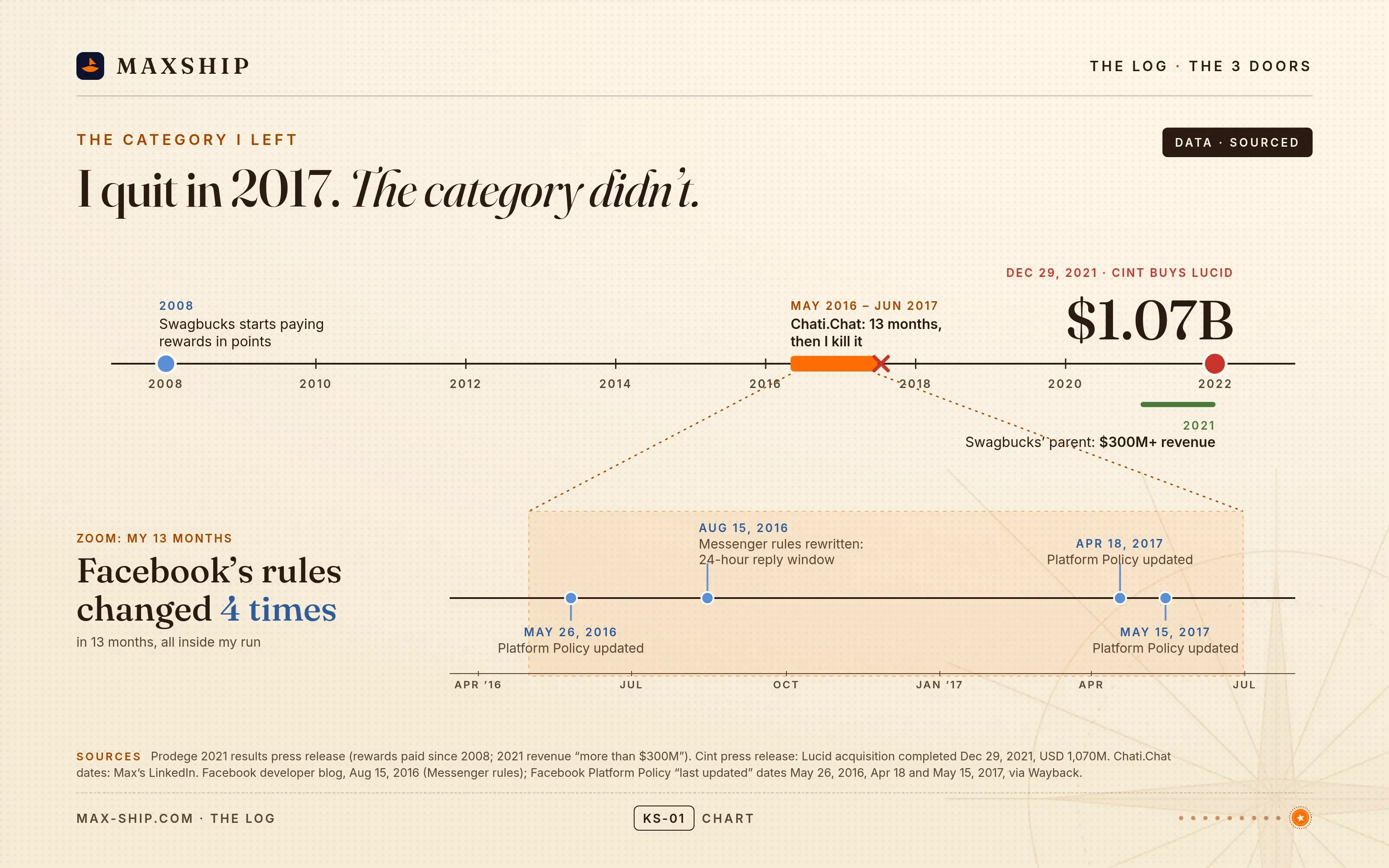
In 2016 I killed my chatbot survey app, Chati.Chat, over a 50-cent problem I couldn't solve. Four years later, a company doing the same thing, matching researchers with survey respondents, sold for $1.07 billion. That was Lucid, bought by Cint.
The idea was to use Facebook's ad targeting to match researchers with the exact people they needed to hear from. But paying someone 20 cents for an answer cost more than the 20 cents. Then Facebook changed its rules four times in 13 months. My competitors didn't solve micropayments. They batched them into gift cards and cash-outs. I lost focus, had another business taking off, and walked through the kill door without looking at the other two.
Lucid wasn't my idea, and nobody stole anything. Lucid was in my category, though, and so was Swagbucks. Swagbucks' parent company did more than $300 million in revenue in 2021.
Now every idea I run gets checkpoints, and every checkpoint has three doors. This post covers the doors, the question behind each one, and the two times I never stood at them.
The 3 Doors
At each checkpoint you can continue, adjust or kill. Before you walk through any door, you answer one question for each of them, even when you think you already know which door you're taking.
- Continue: What has to be true to walk through the continue door confidently?
- Adjust, the timed door: What's the one choke point, and the cheapest fix I can test by a set date?
- Kill: What does quitting cost, and what does staying cost?
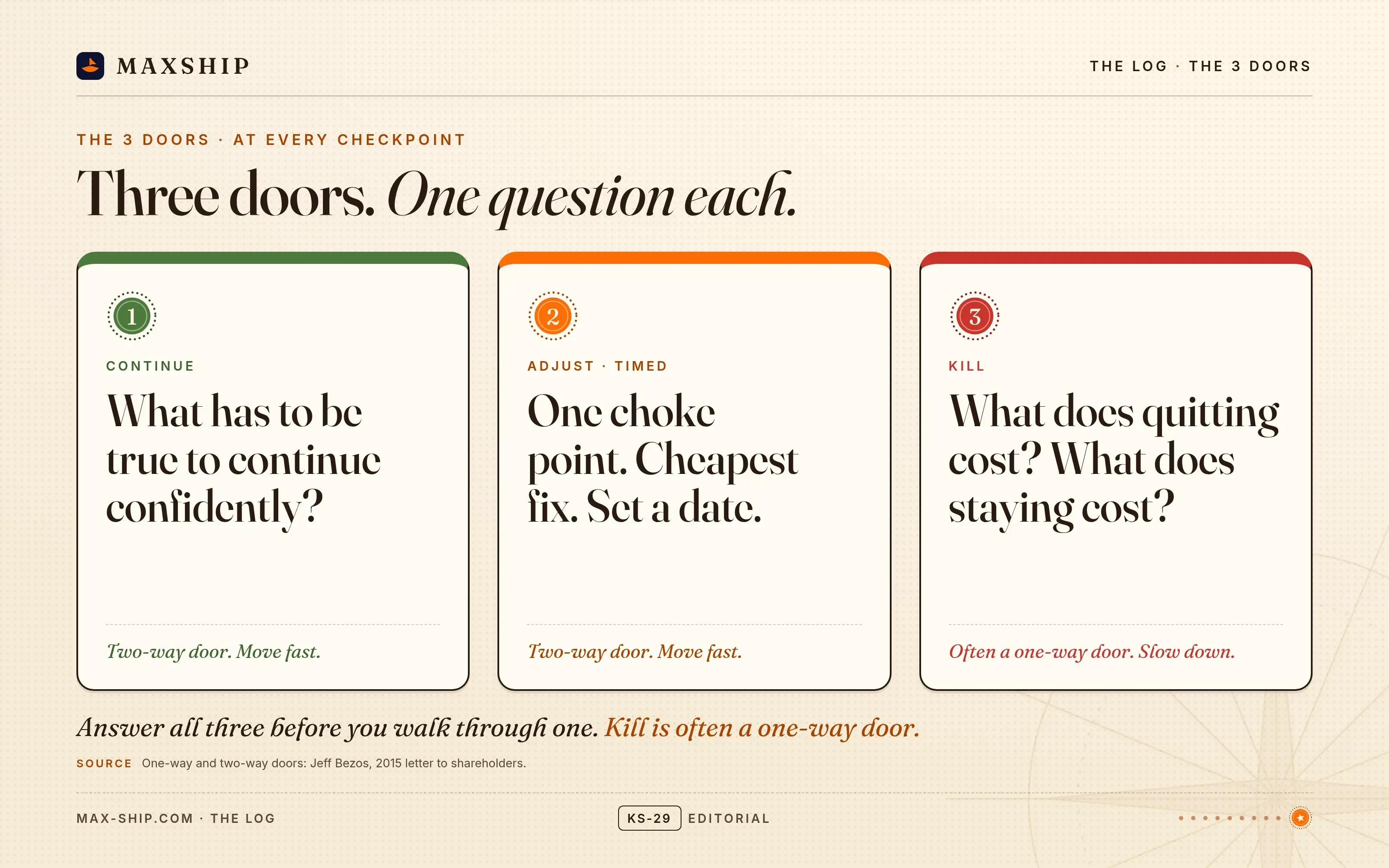
The doors aren't equal. Jeff Bezos split decisions into one-way and two-way doors in his 2015 shareholder letter. One-way doors are hard or impossible to reverse. With a two-way door, "You can reopen the door and go back through." Continue and adjust are two-way doors. If you pick wrong, the next checkpoint catches it, so move fast. Kill is often one-way. That's the door to slow down at.
The doors I never stood at
I co-founded Chati.Chat in San Francisco. We found the right people through Facebook's ad targeting, asked them questions over Messenger and paid them per answer. It was bootstrapped, with a small team, and I paid developers out of my own pocket.
Three things killed it. I'll give you all three, because the clean one-reason version would be a lie.
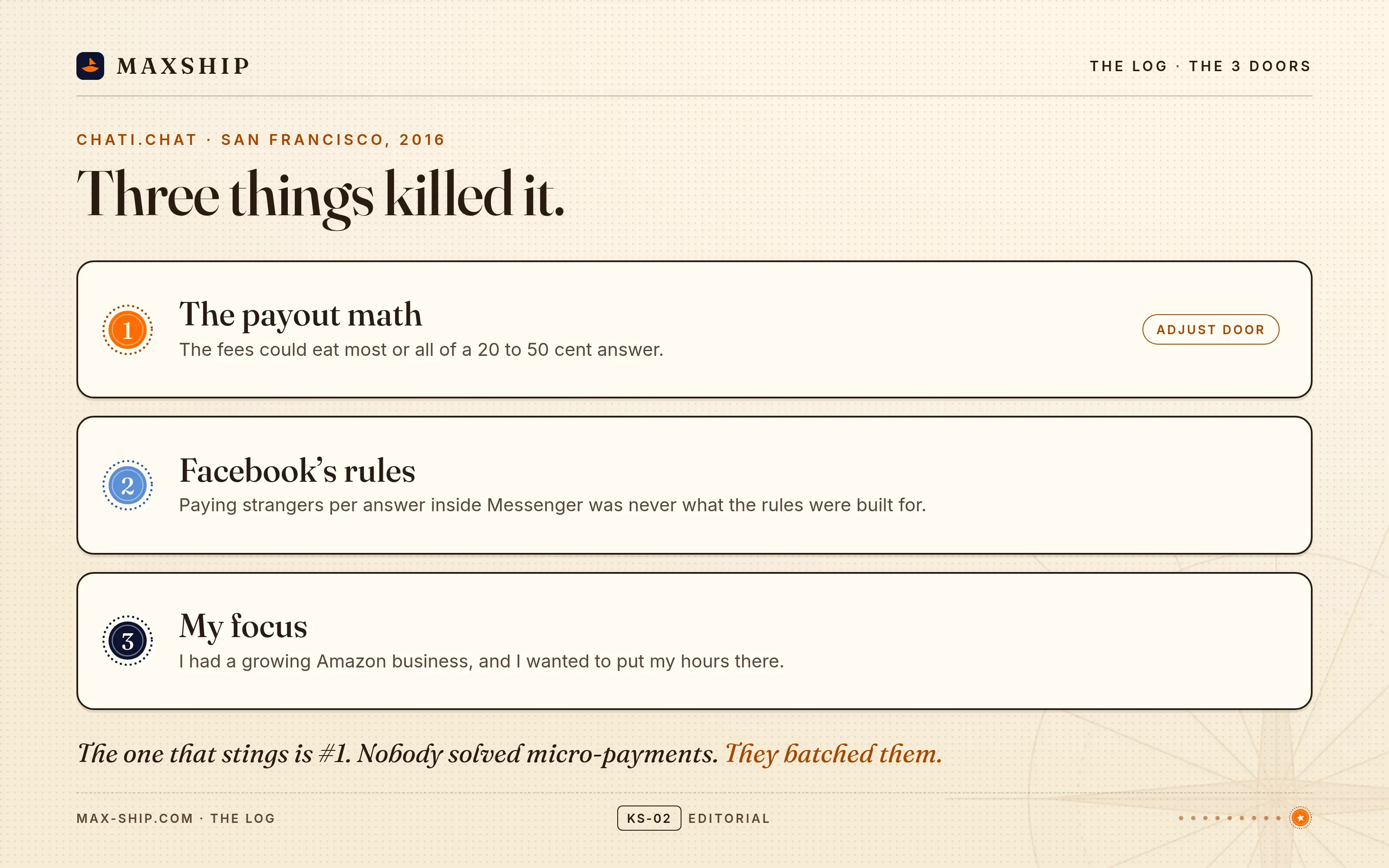
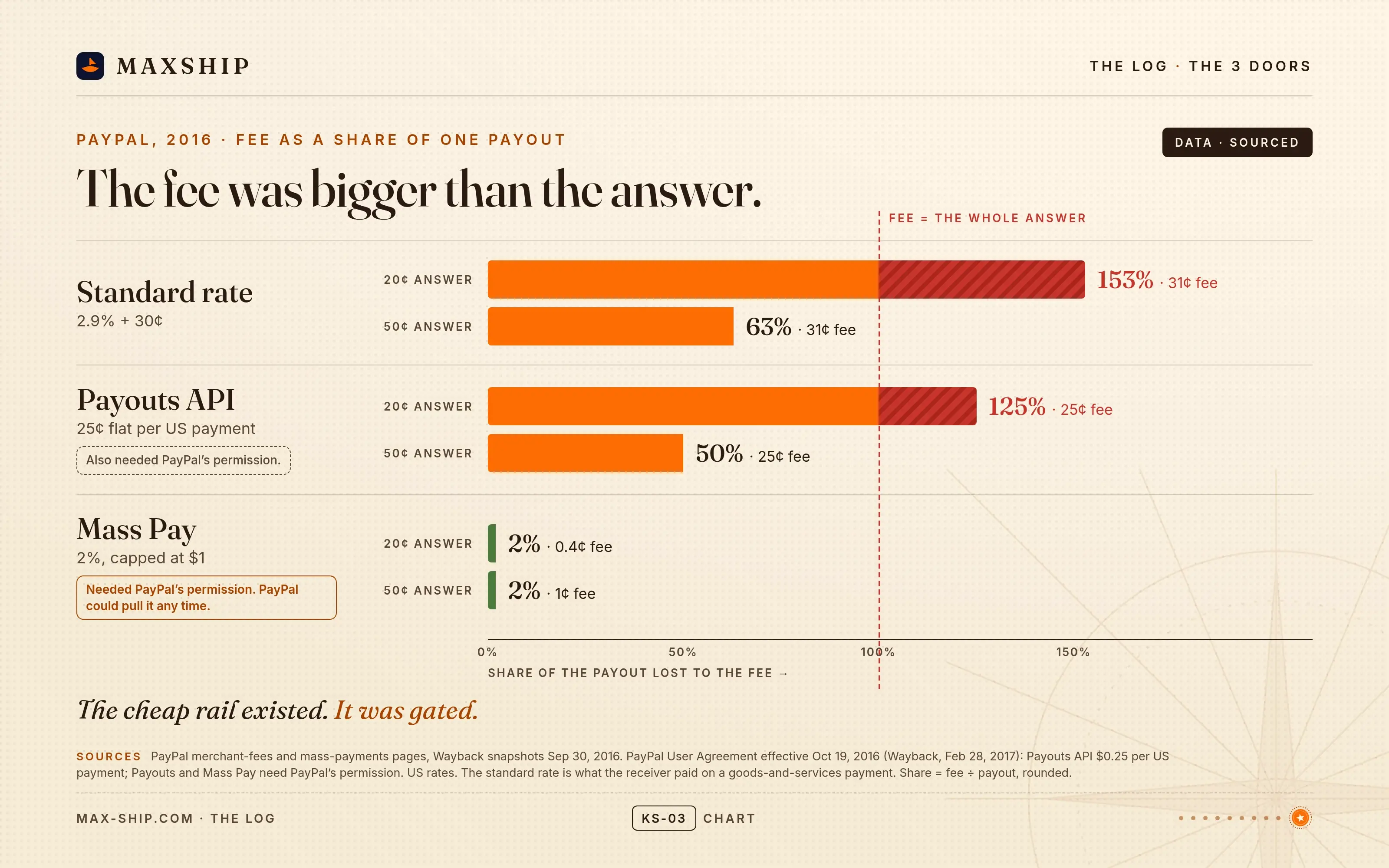
1. The payout math. We paid through PayPal, and the obvious rails were brutal for pocket change. The standard rate was 2.9% plus 30 cents, and PayPal's newer Payouts API charged a flat 25 cents per US payment, so the fee could eat most or all of a 20 to 50 cent answer. On a 20-cent answer, the standard fee was 153% of the answer. The cheap option, Mass Pay at 2%, needed PayPal's permission, and PayPal could pull it any time. I couldn't crack the formula, and I overthought the economics until I talked myself out of it.
2. Facebook's rules. Facebook only opened Messenger to bots in April 2016, then rewrote the Messenger rules that August. From then on you could only message people within 24 hours of their last reply. Opt-in subscription messages were limited to news, productivity and personal trackers. On top of that, the platform policy only let you reward people for logging in, entering a promotion or checking in. Paying strangers per answer inside Messenger was never what those rules were built for. It was a great use of existing tech that the terms didn't make room for. Add the platform policy updates of May 2016, April 2017 and May 2017, and that's four rule changes in the 13 months I ran it.
3. My focus. I had a growing Amazon business at the same time, and I wanted to put my hours there.
The one that stings is the payout problem, because the market had already solved it before I started. Swagbucks had been running on points since 2008. You pile up small earnings and cash out once you pass a threshold. Today that's $5 to PayPal, or a $1 Amazon gift card. Survey Junkie cashes out at $5. Google Opinion Rewards pays Android users in Play credit and only sends PayPal cash once you reach $2. Nobody solved micro-payments. They batched them.
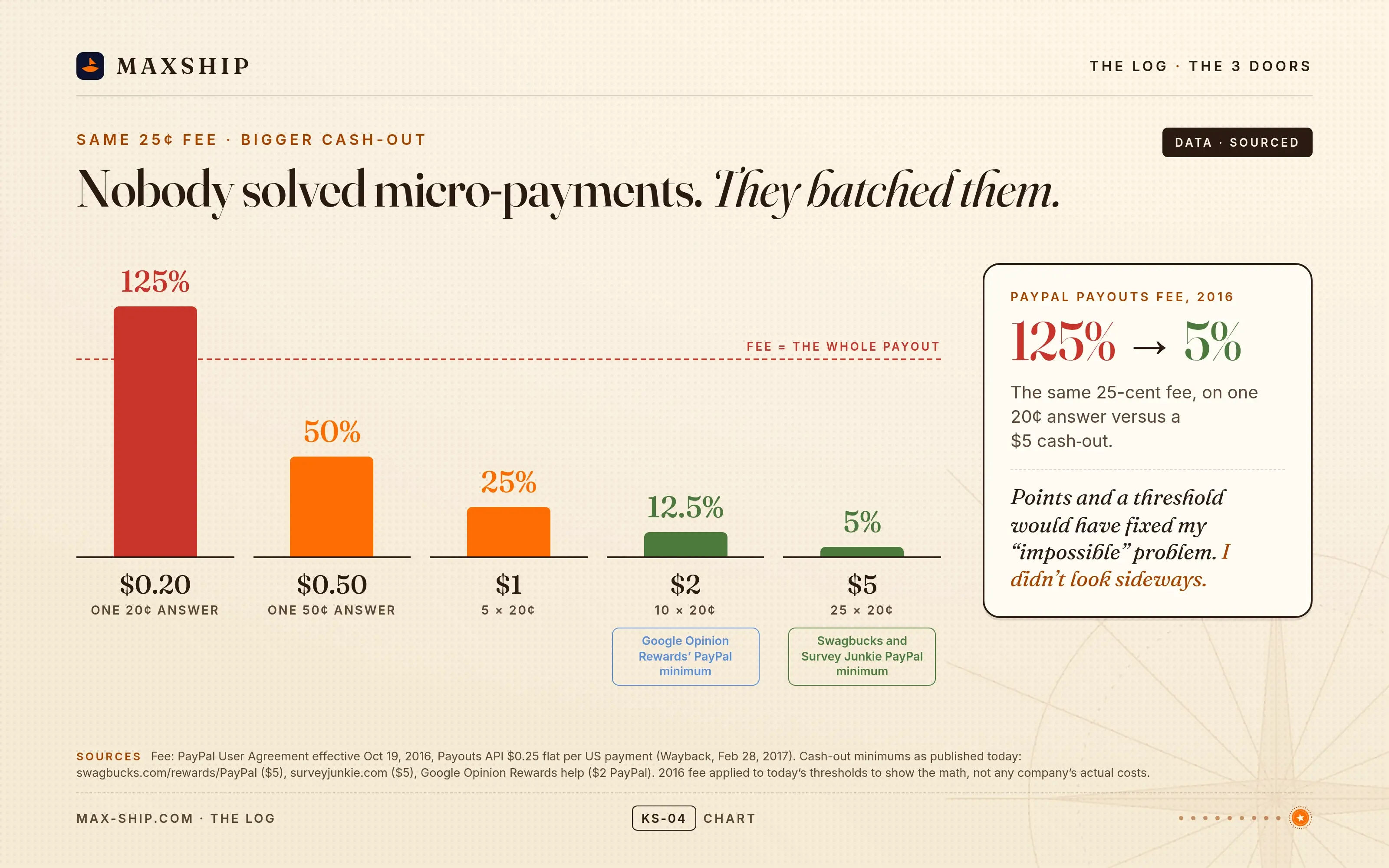
So I killed a whole business over one choke point. That was an adjust door, and I walked through the kill door.
The other way to miss the doors
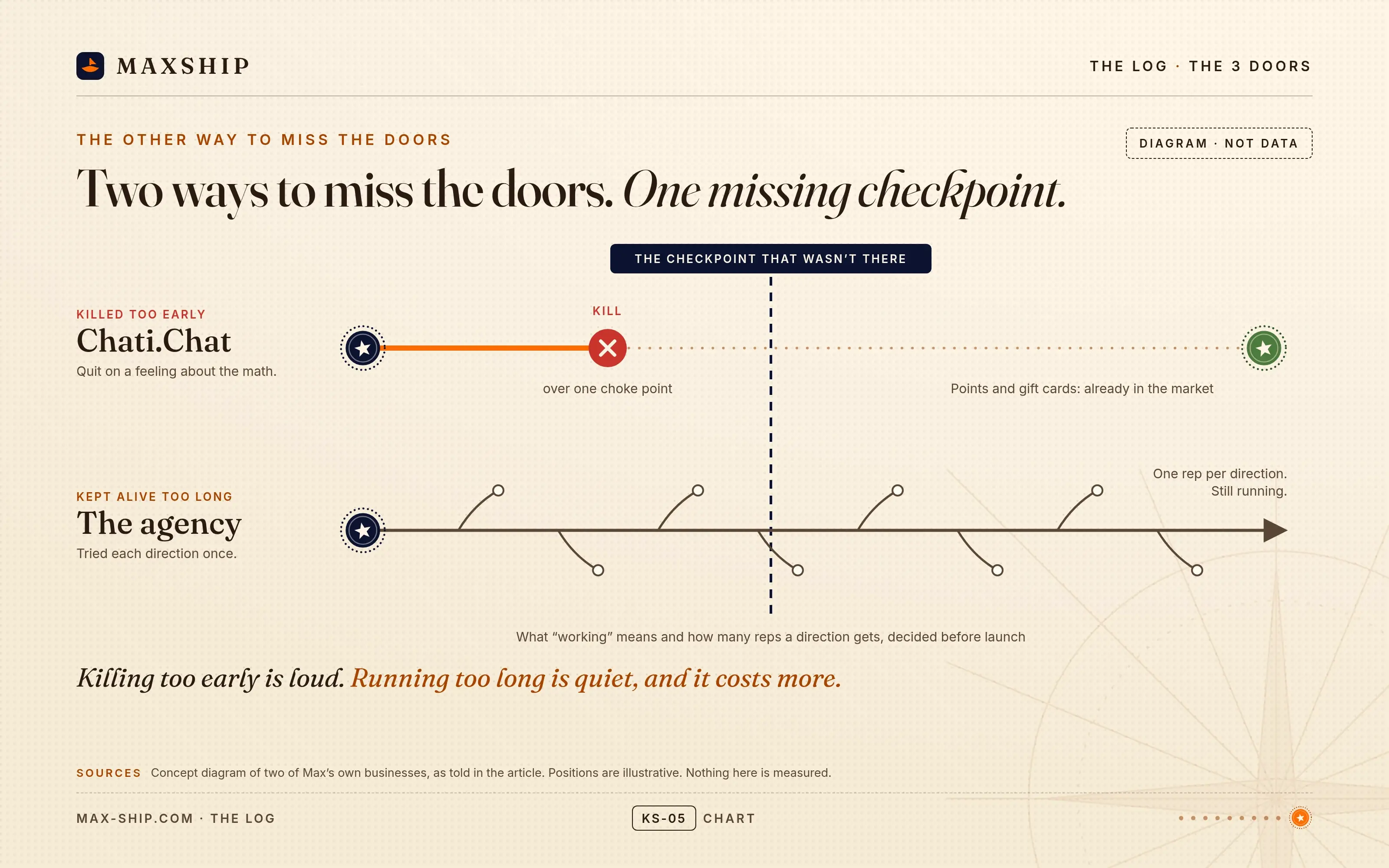
Killing too early is loud. Running too long is quiet, and it costs more.
At an agency I ran, we got stuck in experiment loops. We'd try something, read the tea leaves, then try something else. We tried each direction once and made big decisions off that single data point. One attempt is an anecdote, not a test.
Both failures come from the same place: no checkpoint was set before launch, so I never stood at the doors. With Chati.Chat I quit on a feeling about the math. With the agency I kept going on a feeling that the next experiment would be the one. Neither time had I decided upfront what "working" looked like, or how many reps a direction got before I judged it.
Door 1: Continue
What has to be true to walk through the continue door confidently?
Name the number and the date. "Acquisition cost under my target by day 30" is an answer. "It feels like it's working" isn't.
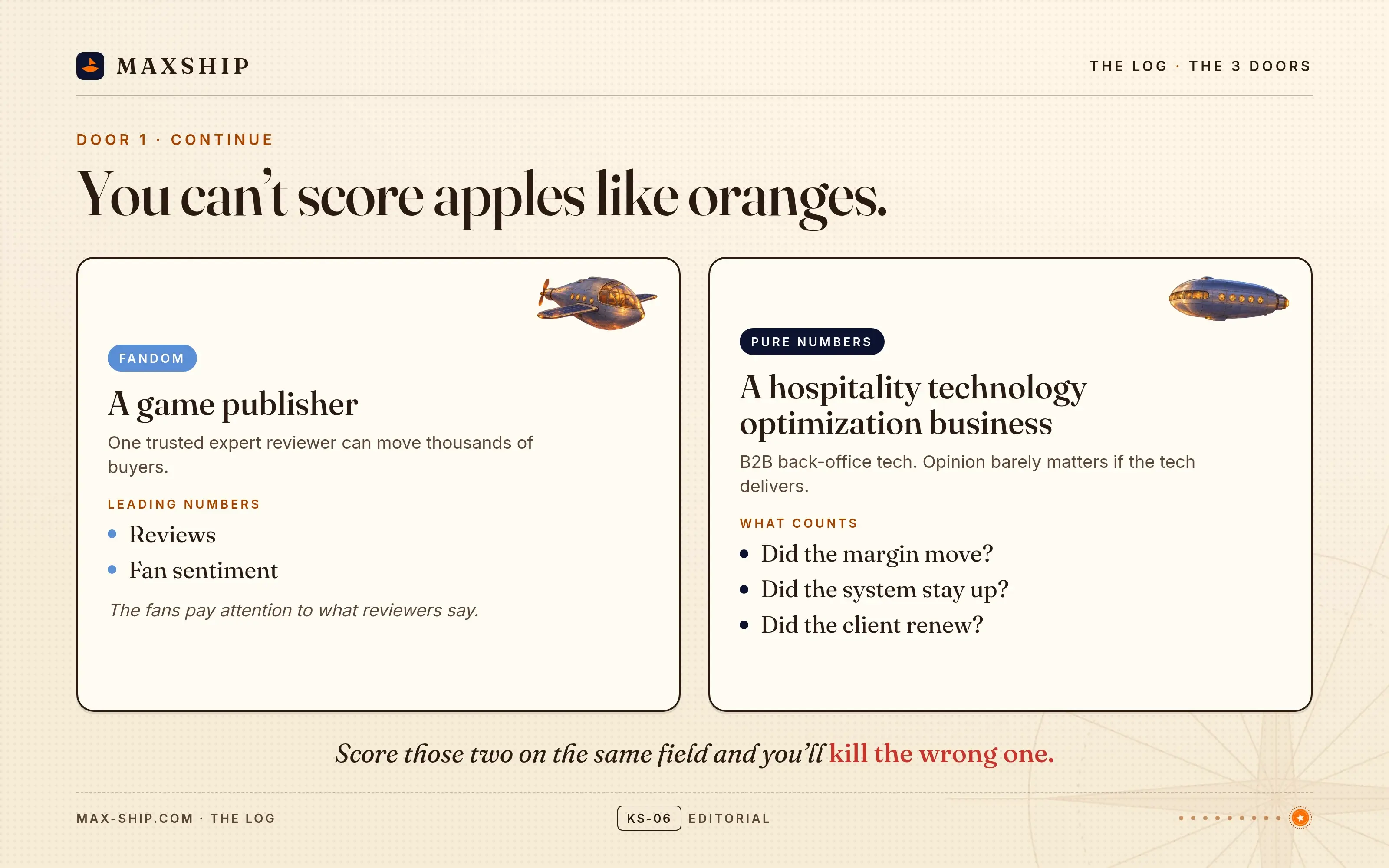
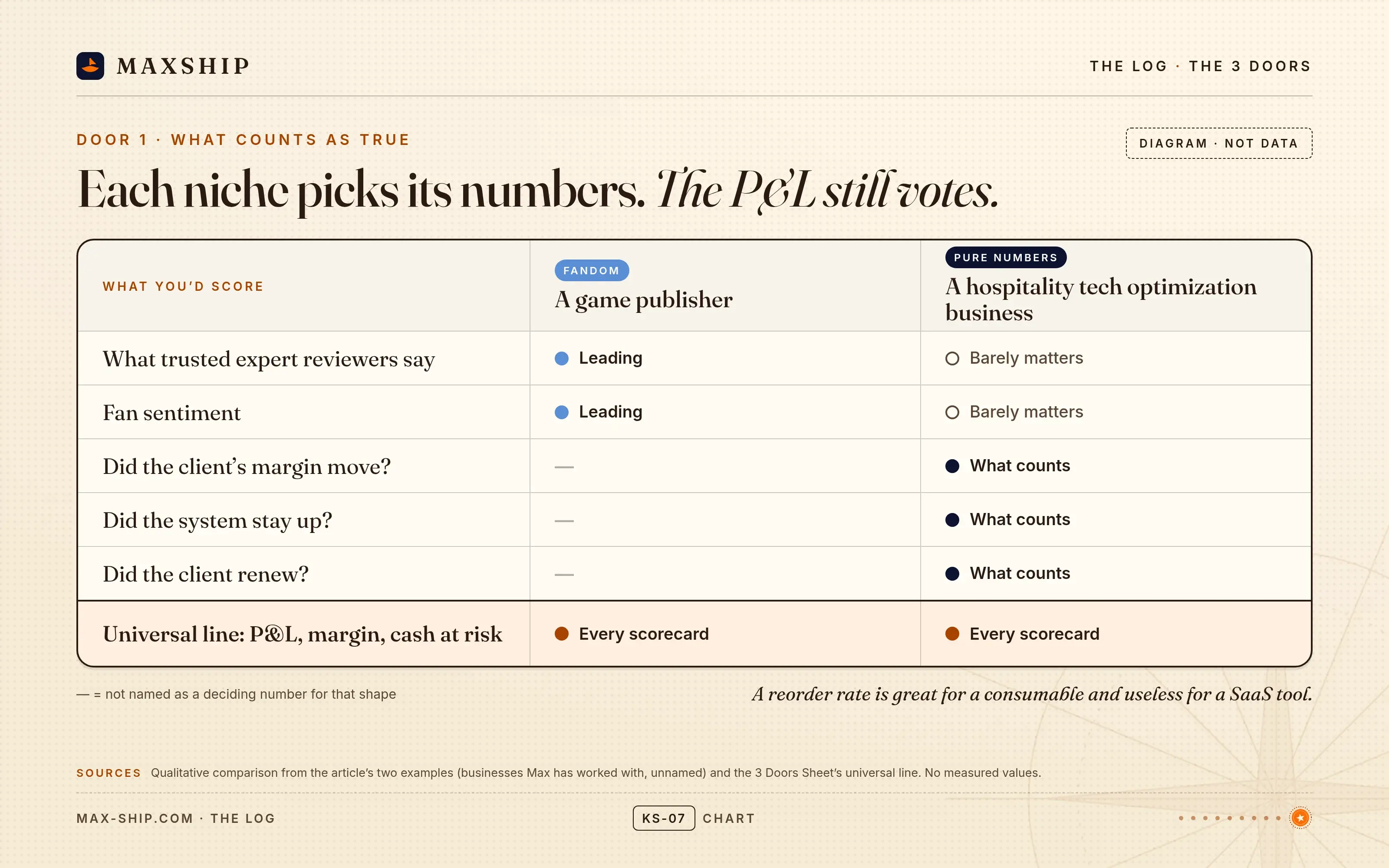
What counts as true depends on the business. Take two I've worked with. A game publisher lives and dies on fandom. One trusted expert reviewer can move thousands of buyers, so reviews and fan sentiment are leading numbers. A hospitality technology optimization business is B2B back-office tech that squeezes small margin and operations gains out of hospitality businesses. Customer opinion barely matters as long as the tech delivers. What counts is whether the margin moved, the system stayed up and the client renewed.
Score those two on the same field and you'll kill the wrong one. And sometimes the number that decides it isn't on the P&L at all. It's a rule, a license or a platform policy, as Chati.Chat proved.
Door 2: Adjust, the timed door
What's the one choke point, and the cheapest fix I can test by a set date?
One change, one test, one deadline. When the date hits, you're back at the doors with real data.
Take a hypothetical. You launch an e-commerce product and your acquisition cost comes in lower than expected, which is great, but returns are high. Don't throw it out. Find the single step with the most friction and fix that first. That might mean better instructions, better packaging or a small product tweak. That's the bottleneck idea from Eli Goldratt's Theory of Constraints: a system only moves as fast as its tightest point.
Change one variable, whether that's the offer, the audience, the channel, the price or the product. Then give it enough reps to mean something, and set the date you judge it. That's the agency lesson again.
Door 3: Kill
What does quitting cost, and what does staying cost?
Put both on the table in hours, dollars and focus. Staying costs you the next idea you're not building. Then use the test Barry Staw and Jerry Ross put in HBR back in 1987. Picture yourself taking over the project today and ask: "would I support it or get rid of it?" The money you already spent shouldn't change that answer.
Then ask whether it's a one-way door. Once the team is gone, the users have drifted and the code is stale, you usually can't walk back in.
And before you touch the handle, look sideways. The fix for my "impossible" payout problem was points and gift cards, and they were sitting right there in the market while I was building.
After you pick a door
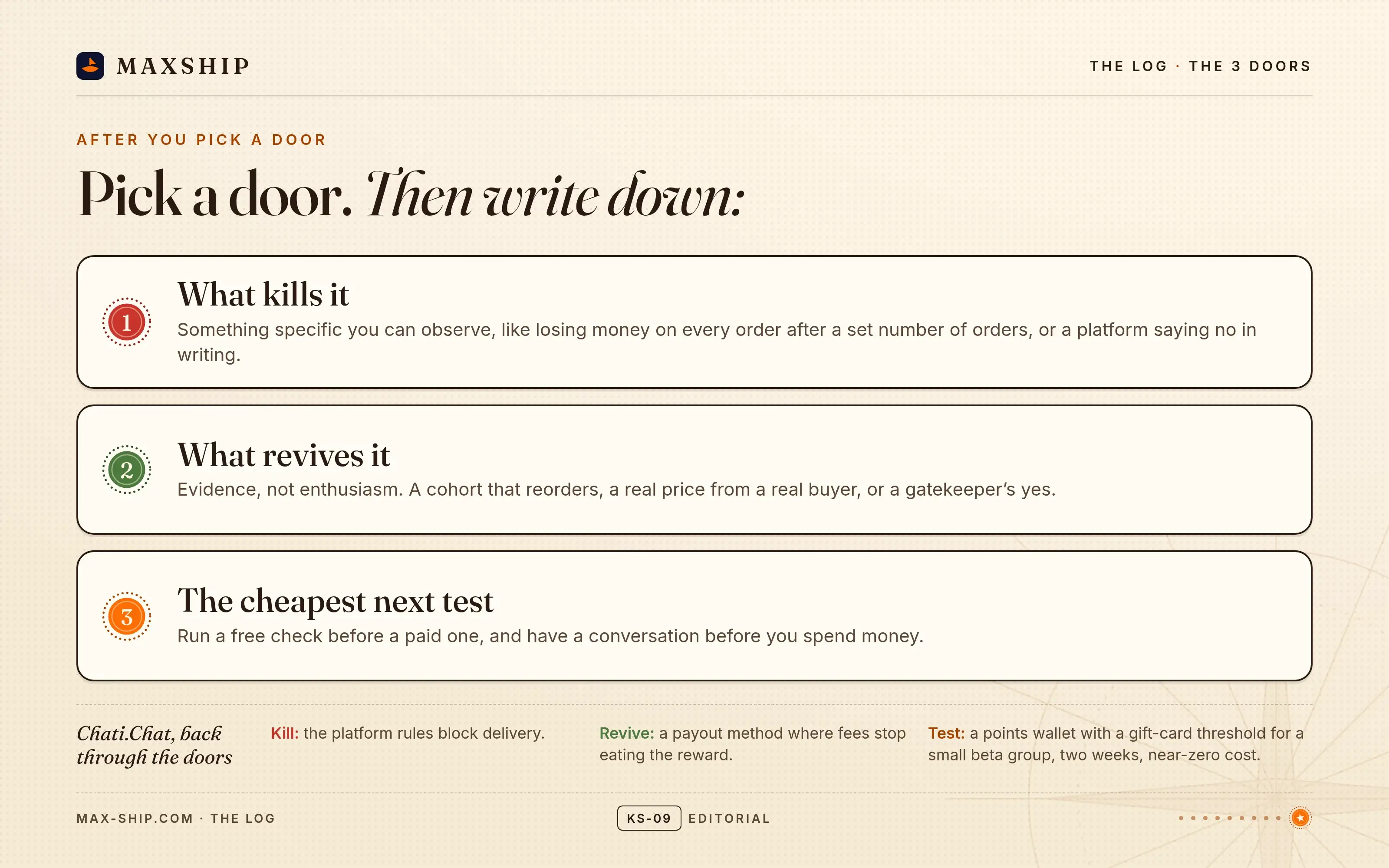
Whichever door you walk through, write down three things:
- What kills it. Something specific you can observe, like losing money on every order after a set number of orders, or a platform saying no in writing.
- What revives it. Evidence, not enthusiasm. A cohort that reorders, a real price from a real buyer, or a gatekeeper's yes.
- The cheapest next test. Run a free check before a paid one, and have a conversation before you spend money.
Run Chati.Chat back through the doors. The choke point was the payout. Kill: the platform rules block delivery. Revive: a payout method where fees stop eating the reward. Cheapest next test: a points wallet with a gift-card threshold for a small beta group, two weeks, near-zero cost. I never ran that test. I skipped the adjust door and walked through a one-way door.
When you stand at the doors
You stand at the doors at gates: scheduled check-ins with yourself, and your partners if you have them. Here's one example clock, for a consumer product people reorder fast:
- Day 15: ad and creative signal, cost to acquire a customer
- Day 30: early retention
- Day 45: conversion and first reorders
- Day 60: reorder pace
- Day 90: lifetime value and the big verdict
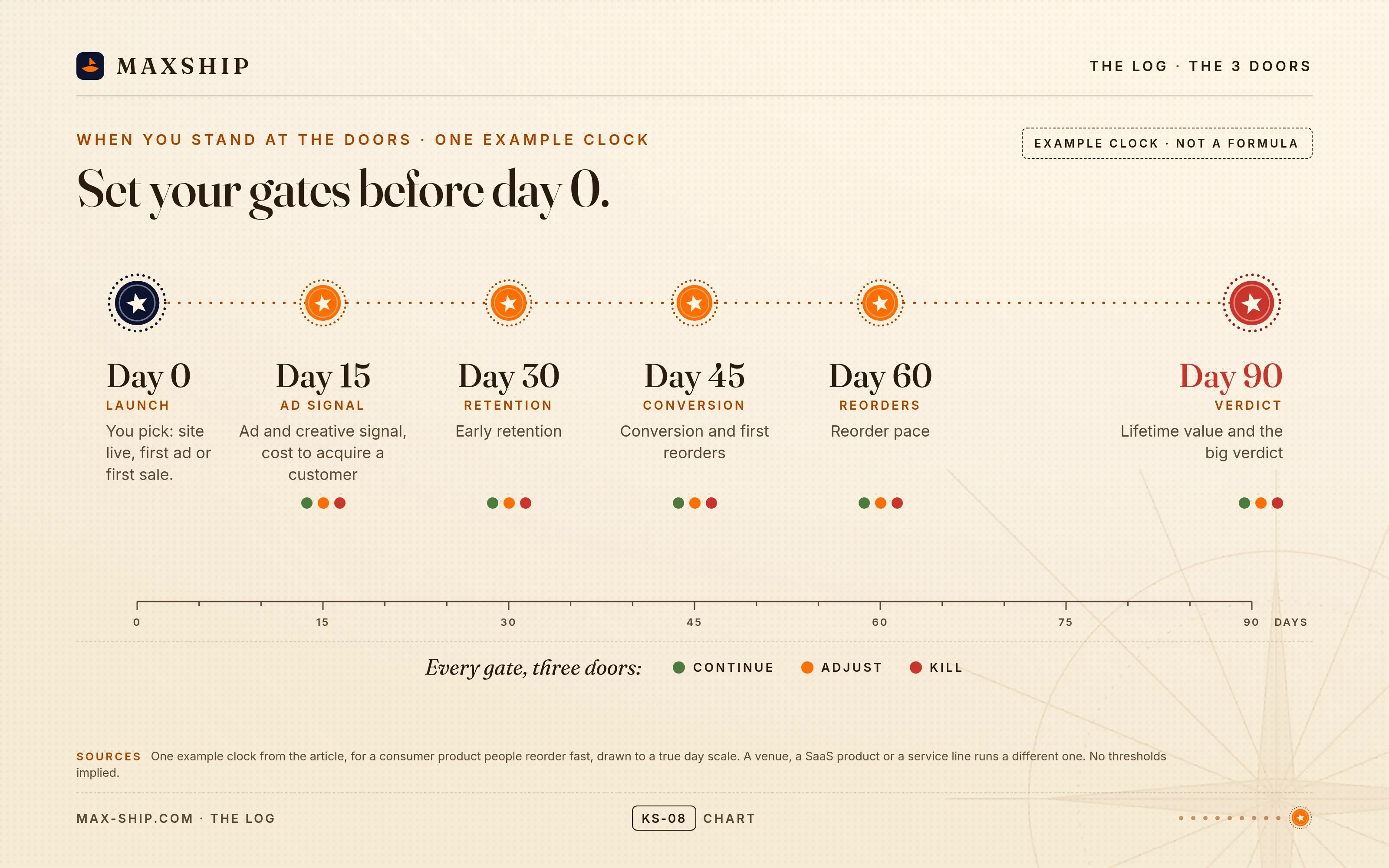
That's one niche's clock. A venue, a SaaS product or a service line runs a different one. Set yours before day 0, and decide what day 0 even means (site live, first ad or first sale).
AI shrinks the early gates. I can build a site, an app, ad creative and a launch fast enough that six months of "is there anything here?" becomes a couple of weeks (here's how I build a site with AI). It can't rush reorders, loyalty or trust, so don't walk through the kill door on a slow question using fast data.
Who opens the door
The captain picks how the call gets made. It depends on your time, budget, effort and reason for doing it. Three setups work:
- Pure numbers, ruthless. Set thresholds in advance and let the numbers pick the door.
- An automated KPI kill. For example, a subscription business shuts itself off if acquisition cost or lifetime value isn't better than average by the gate. (I wire tripwires like this in PostHog.)
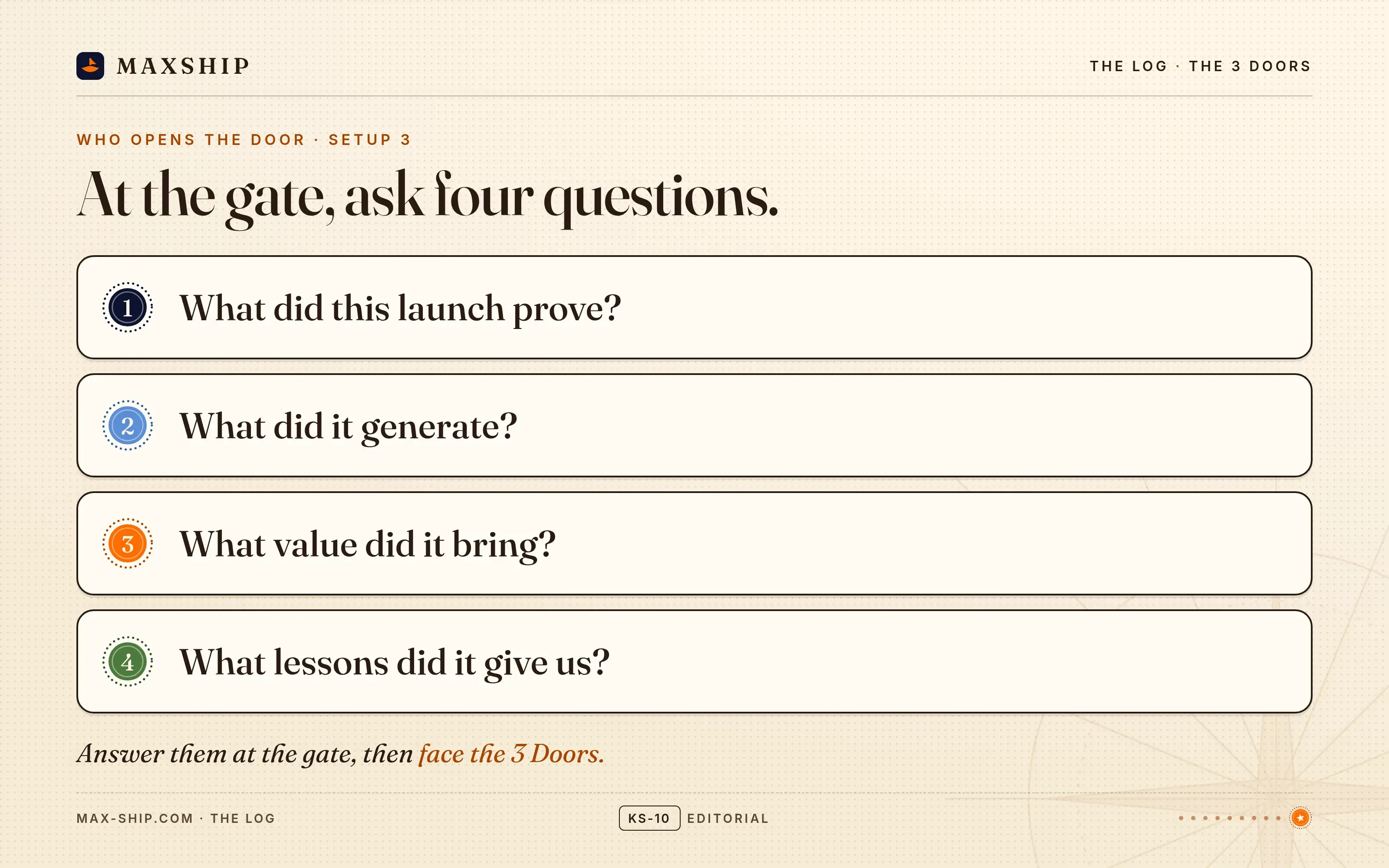
- Gate questions. What did this launch prove? What did it generate? What value did it bring? What lessons did it give us? Answer them at the gate, then answer the 3 Doors and decide on the spot.
AI can watch the dashboards. The captain still has to stay awake at the wheel.
My gut at the doors
My gut wins on executive, brand, customer-experience, design and creative calls. There's a line attributed to Henry Ford: "If I had asked people what they wanted, they would have said faster horses." Sometimes the captain sees past what customers can put into words.
The spreadsheet picks the door. Gut decides what to try. The numbers decide whether it worked.
My gut has also lied to me, in two patterns I've learned to override.
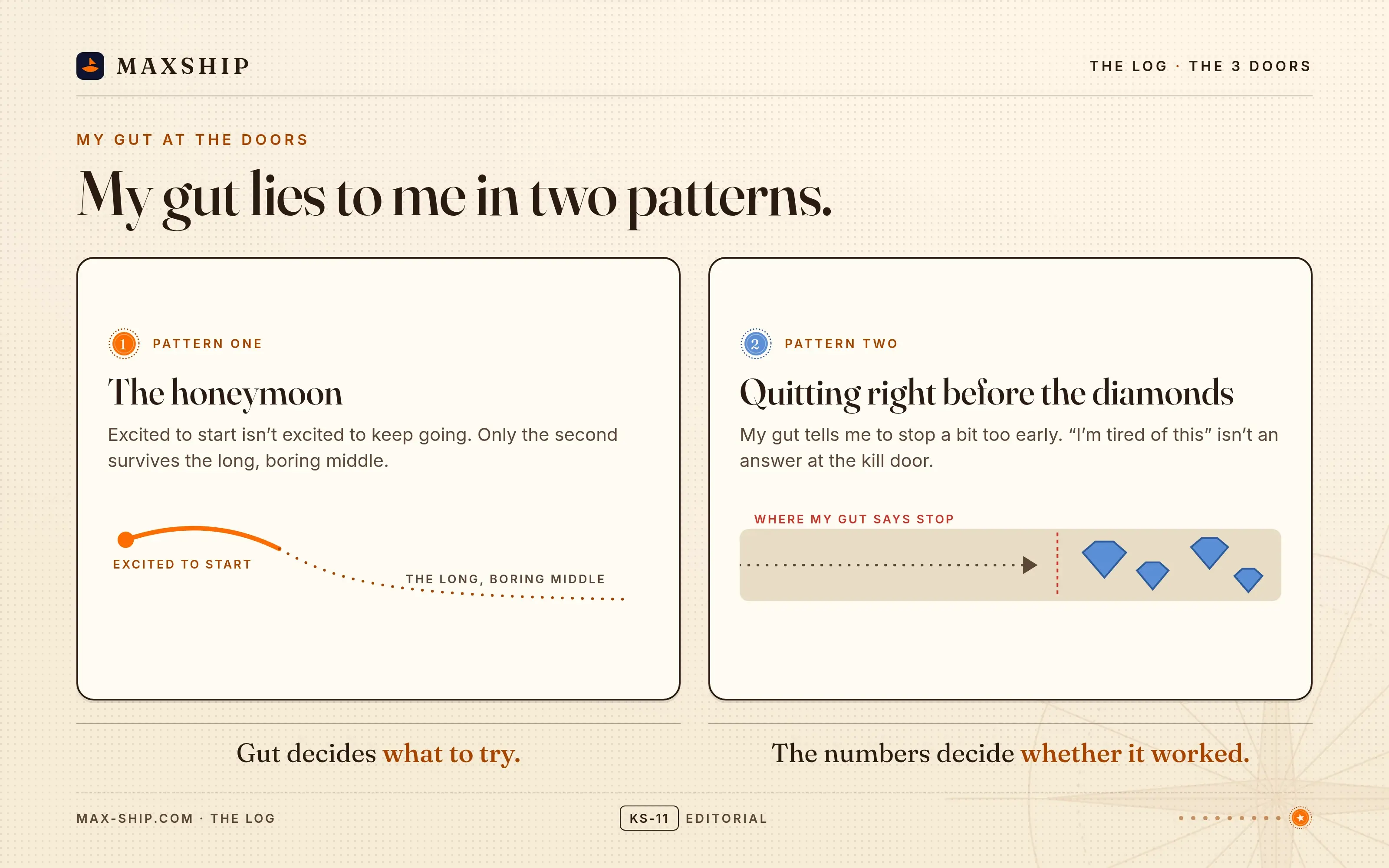
The honeymoon. When I get excited about something, I take it as a sign I should do it. A lot of that excitement is the honeymoon phase of a romance that won't last. Being excited to do something is different from being excited to do it for a very long time, and only the second one survives the long, boring middle.
Quitting right before the diamonds. You've probably seen the meme: a miner tunneling through rock turns around and walks away, and he's inches from a wall of diamonds. My gut tells me to stop a bit too early. The doors are how I catch it, because "I'm tired of this" isn't an answer at the kill door.
Before the doors comes the pick
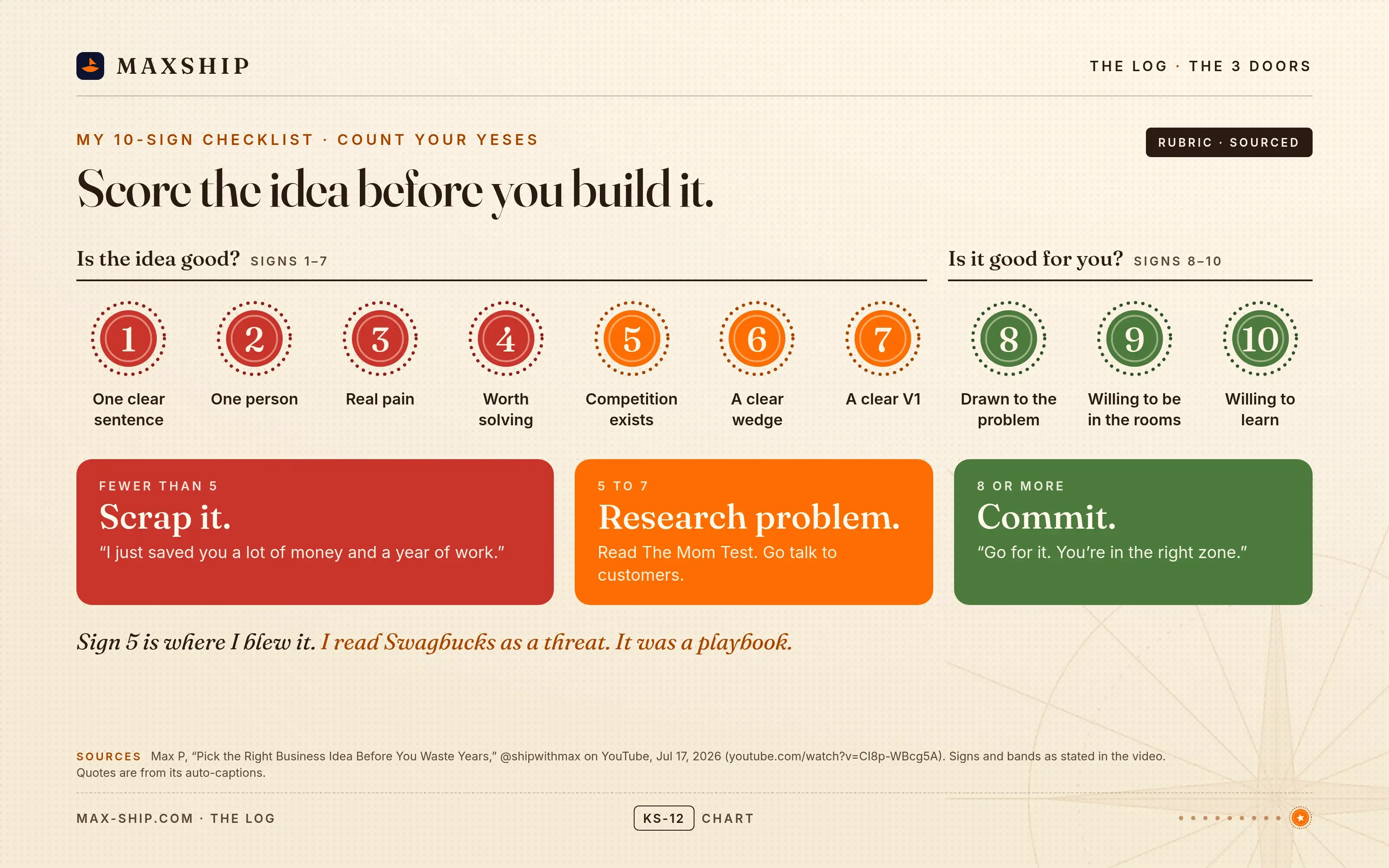
Everything above is for after you launch. Picking the idea comes first, and I covered it in my 10-sign checklist video. Sign five is that competition is proof the dogs are eating the dog food. With Chati.Chat I saw Swagbucks as a threat when it was actually a playbook.
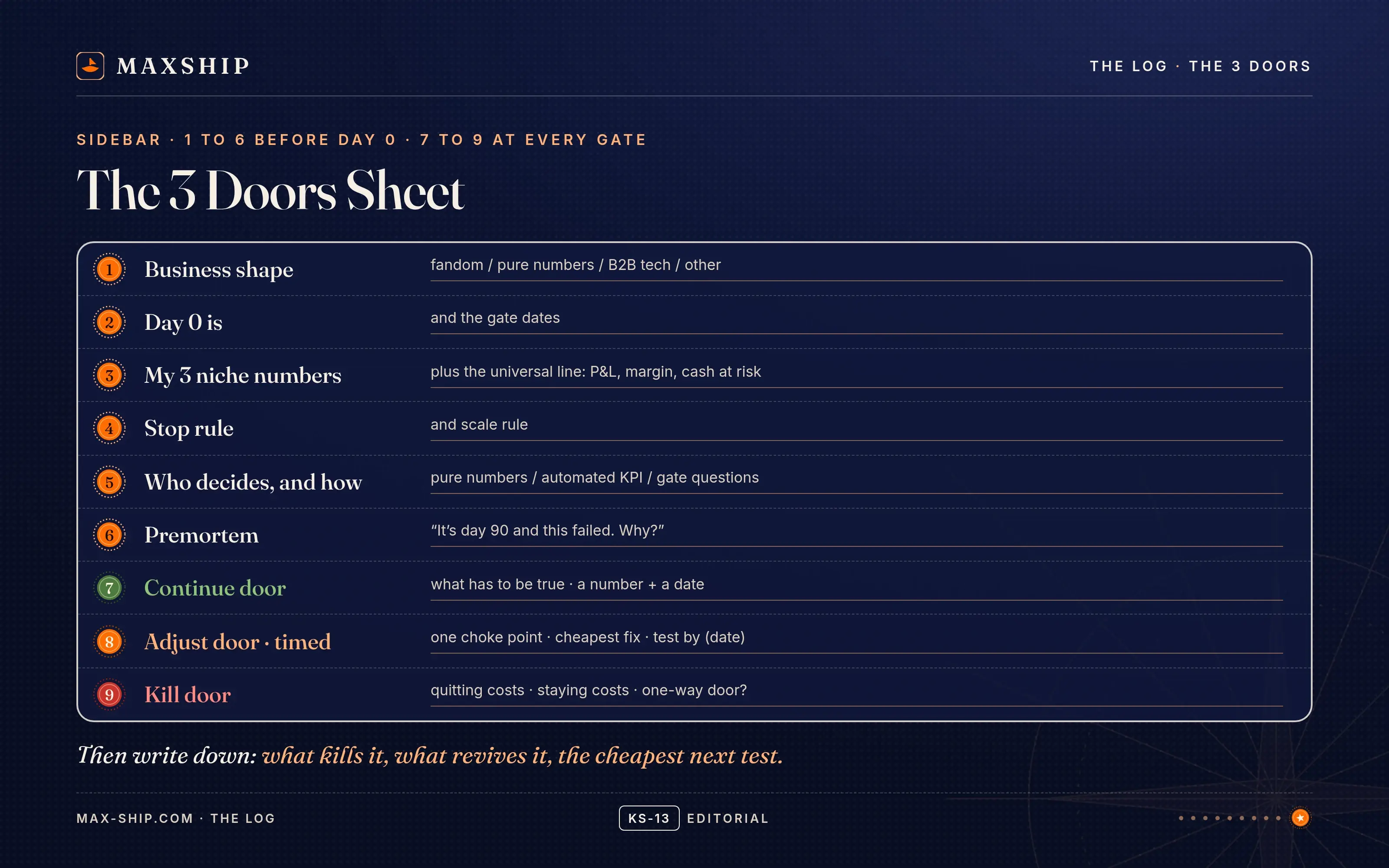
Sidebar: The 3 Doors Sheet
Fill in 1 to 6 before day 0. Fill in 7 to 9 at every gate.
- Business shape: fandom / pure numbers / B2B tech / other: ______
- Day 0 is: ______ Gate dates: ______
- My 3 niche numbers: ______ Universal line (P&L, margin, cash at risk): ______
- Stop rule: ______ Scale rule: ______
- Who decides, and how (pure numbers / automated KPI / gate questions): ______
- Premortem: "It's day 90 and this failed. Why?" ______
- The continue door: what has to be true (a number + a date)? ______
- The adjust door (timed): one choke point ______ cheapest fix ______ test by (date) ______
- The kill door: quitting costs ______ staying costs ______ one-way door? yes / no
Then write down: door picked ______ what kills it ______ what revives it ______ cheapest next test ______
Prompts for the doors
Paste these into any AI chat and fill in the brackets:
- Before day 0: set my gates and my 3 Doors, and run a premortem.
I'm about to launch [IDEA]. Before I start, help me set my gates and my 3 Doors answers.

Business shape: [fandom / pure numbers / B2B tech / other]
Day 0 means: [site live / first ad / first sale]
Time and money I can risk: [AMOUNT]

1. Pick the 3 numbers that matter most for this shape, and say why.
2. Set gates for my niche (for example day 15, 30 and 90) and what each one checks.
3. For each gate, answer the 3 Doors: what has to be true to continue (a number and a date), the one choke point and the cheapest fix I can test by a set date, and what quitting costs vs. what staying costs.
4. Write my stop rule and my scale rule in one sentence each.
5. Flag which of these choices are one-way doors.

"I'm tired of this" is not an answer at the kill door. Don't let me use it.Run a premortem on [IDEA].
It's day 90 and this failed. Write the post-mortem.
- Give me the 5 most likely reasons, ranked by how likely they are.
- For each one, name the earliest signal I'd see and the day I'd see it.
- Flag any reason that's a rule, a license or a platform policy, not a P&L number.
- Tell me the cheapest test I could run this week to rule out the top reason.
Be blunt. I'd rather hear it now than on day 90.- At the continue door: honeymoon or a 5-year interest?
Am I excited about [IDEA], or excited about a new toy?

Interview me. Ask one question at a time, 7 questions max, about:

- what I'd be doing on a boring Tuesday in year 3
- the parts of the work I'd have to do every single week
- the lifestyle this business drags behind it if it works

Then tell me straight: is this honeymoon excitement or a 5-year interest? Quote my own answers back as evidence.- At the adjust door: find the choke point before I kill it.
My launch has a problem. Help me find the choke point before I kill it.

What's working: [e.g. acquisition cost is lower than expected]
What's not: [e.g. returns are high]
My funnel: [e.g. ad > page > checkout > delivery > reorder]

1. Name the single step with the most friction, and show your reasoning.
2. Give me 3 fixes for that step only, cheapest first.
3. Pick one variable to change (offer, audience, channel, price or product) and tell me how many reps it needs and the date I judge it by. This is the timed adjust door.

Don't pitch me a new idea. Fix this one first.- At the kill door: look sideways before I hit kill.
I'm about to kill [IDEA] because of [THE PROBLEM].

Before I do, look sideways:

1. Who in this category has already solved this problem or worked around it? Name real companies and say how they did it.
2. Is this a kill door or an adjust door? And is killing it a one-way door? Explain why.
3. If it's an adjust door, what's the cheapest 2-week test of the workaround?

Only name companies you're confident exist. If you're not sure, say so.
The short version
Set your gates before you launch and read your own niche's numbers. At every gate, answer all 3 Doors before you walk through one. Continue and adjust are two-way doors, so move fast. Kill is often one-way, so slow down. Before you open the kill door, look sideways. Someone in your category may have already paid for the answer.
If you're picking your next idea, start with the 10-sign checklist. If you're already running one, copy the 3 Doors Sheet, set your gates this week, and answer all three doors at the first one. I post what I'm building, and what I kill, on X @PalafoxPalmer.
Sources
- Cint completes Lucid acquisition (USD 1,070M, Dec 29, 2021): https://news.cision.com/cint-ab/r/cint-group-ab--publ--completes-the-acquisition-of-lucid-holdings--llc,c3479611
- Cint to acquire Lucid (deal terms): https://news.cision.com/cint-ab/r/cint-group-ab--publ--to-acquire-lucid--intends-to-raise-equity-and-has-secured-debt-financing,c3441847
- Prodege 2021 results (more than $300M revenue): https://www.prodege.com/resources/press-release/audience/prodeges-record-year-showcases-innovation-in-evolving-tech-landscape-and-charts-a-strong-course-for-2022/
- Swagbucks PayPal and gift-card thresholds: https://www.swagbucks.com/rewards/PayPal
- Survey Junkie $5 cash-out: https://www.surveyjunkie.com/
- Google Opinion Rewards $2 PayPal threshold: https://support.google.com/opinionrewards/answer/7378183
- Facebook, "Bots for Messenger" (Apr 12, 2016): https://developers.facebook.com/blog/post/2016/04/12/bots-for-messenger/
- Facebook, "Updated Messenger Platform Policies" (Aug 15, 2016): https://developers.facebook.com/blog/post/2016/08/15/updated-messenger-platform-policies/
- TechCrunch on the Aug 2016 Messenger rules: https://techcrunch.com/2016/08/16/i-bot/
- Facebook Platform Policy as of Dec 2016 (incentives, data use, Messenger): https://web.archive.org/web/20161216072616/https://developers.facebook.com/policy/
- Chati.Chat dates and role: https://linkedin.com/in/shipwithmax
- Facebook Platform Policy "Last updated" dates, Wayback snapshots: May 26, 2016 https://web.archive.org/web/20160702033128/https://developers.facebook.com/policy · Apr 18, 2017 https://web.archive.org/web/20170426042503/https://developers.facebook.com/policy/ · May 15, 2017 https://web.archive.org/web/20170614040328/https://developers.facebook.com/policy/ (plus the Aug 15, 2016 Messenger rewrite above = four changes, May 2016 to Jun 2017)
- Jeff Bezos, 2015 letter to shareholders (one-way and two-way doors): https://www.sec.gov/Archives/edgar/data/1018724/000119312516530910/d168744dex991.htm
- Barry M. Staw and Jerry Ross, "Knowing When to Pull the Plug," HBR, March 1987: https://hbr.org/1987/03/knowing-when-to-pull-the-plug
- Gary Klein, "Performing a Project Premortem," HBR, September 2007: https://hbr.org/2007/09/performing-a-project-premortem
- Theory of Constraints, introduced in Eliyahu Goldratt's The Goal (1984), Theory of Constraints Institute: https://www.tocinstitute.org/history-of-toc.html
- "Faster horses" quote, attributed to Henry Ford, with no evidence he said it (Quote Investigator): https://quoteinvestigator.com/2011/07/28/ford-faster-horse/
- PayPal standard rate, 2.9% + $0.30 (merchant fees, Sep 2016): https://web.archive.org/web/20160930120748/https://www.paypal.com/us/webapps/mpp/merchant-fees
- PayPal Mass Pay, 2% capped at $1 (Sep 2016): https://web.archive.org/web/20160930120820/https://www.paypal.com/us/webapps/mpp/mass-payments
- PayPal User Agreement (effective Oct 19, 2016): Payouts API flat $0.25 per US payment, Payouts and Mass Pay need PayPal's permission: https://web.archive.org/web/20170228230632/https://www.paypal.com/us/webapps/mpp/ua/useragreement-full
- Full notes: source-facebook-terms-2016.md, source-paypal-2016.md